OpenAI patents analog circuit that learns by balancing electrical energy
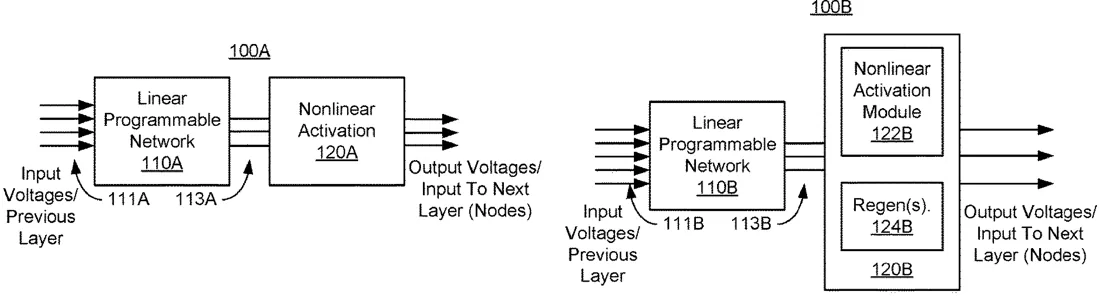
OpenAI describes a hardware system that uses physical electrical circuits to perform learning tasks instead of standard digital chips. The design uses a method called equilibrium propagation, where the system settles into a stable state of minimum energy to process information. It measures small changes in voltage to adjust its internal settings, allowing the circuit to learn from data.
In the filing’s own words
A system for performing learning is described. The system includes a linear programmable network layer and a nonlinear activation layer. The linear programmable network layer includes inputs, outputs and linear programmable network components interconnected between the inputs and the outputs. The nonlinear activation layer is coupled with the outputs. The linear programmable network layer and the nonlinear activation layer are configured to have a stationary state at a minimum of a content of the system.
What exactly they claim (claim 1)
1. A system for performing learning, comprising: a linear programmable network layer including a plurality of inputs, a plurality of outputs and a plurality of linear programmable network components interconnected between the plurality of inputs and the plurality of outputs; a nonlinear activation layer coupled with the plurality of outputs, wherein the nonlinear activation layer further includes: a nonlinear activation module; and a regeneration module coupled with the plurality of outputs and with the nonlinear activation module, the regeneration module being configured to scale a plurality of output signals from the plurality of outputs, wherein the regeneration module includes a bidirectional amplifier, wherein the regeneration module scales voltage in a forward direction towards output voltages or a next layer by a gain factor of G, wherein the regeneration module scales current in a reverse direction towards input voltages by a gain factor of 1/G, and wherein in the event that G is equal to 1, the regeneration module behaves as a short circuit and maintains a minimum of a content for the system such that in response to the input voltages, the output voltages have a stationary state at the minimum of the content for the linear programmable network layer and the nonlinear activation layer; and an additional linear programmable layer including an additional plurality of inputs, an additional plurality of outputs, and an additional plurality of linear programmable network components interconnected between the additional plurality of inputs and the additional plurality of outputs, the nonlinear activation layer coupled to the additional plurality of inputs, wherein the linear programmable network layer, the nonlinear activation layer, and the additional linear programmable layer are configured to have the stationary state at the minimum of the content for the system, the content for the system corresponding to a pseudo-power for electrical characteristics of the system, wherein a plurality of input signals provided to the plurality of inputs result in a plurality of output signals at the plurality of outputs, result in an additional plurality of output signals at the additional plurality of outputs, and correspond to the stationary state, and wherein the plurality of additional outputs are configured to receive a plurality of perturbations that results in a plurality of perturbation output signals at the plurality of outputs, the plurality of outputs including a plurality of nodes configured to measure the plurality of perturbation output signals, a gradient for the plurality of linear programmable network components of the linear programmable network layer being based on the plurality of perturbation output signals and the plurality of output signals, at least one of the plurality of linear programmable network components in the linear programmable network layer being configured to be reprogrammed based on the gradient.
Facts
- Company
- OpenAI (OpenAI Opco, LLC)
- Official title
- Analog system using equilibrium propagation for learning
- Patent number
- US12749002B2
- Application number
- 16892037
- Filed
- Jun 3, 2020
- Granted
- Sep 29, 2026
- Inventors
- 1
- Claims
- 20
Classified under
G06N 20/00 Physics & computingG06N 3/048 Physics & computingG06N 3/065 Physics & computingG06N 3/084 Physics & computingMore from OpenAI in Chips & hardware
- OpenAI patents chip design that learns while processing data Sep 29, 2026
- OpenAI patents memory chip design to update AI weights while calculating Sep 17, 2026
- OpenAI patents chip design that switches between math types to save power Oct 13, 2026
- OpenAI patents chip design that flips math operations without moving data Sep 17, 2026
- OpenAI patents device that shakes to get your attention Oct 8, 2026
Summaries are simplified from the filing’s own abstract and first claim. A patent filing is not a product announcement.
Patent data and drawings: U.S. Patent and Trademark Office (USPTO). Nebula is not affiliated with or endorsed by the USPTO.