Google patents wearable tech that adjusts light sensors to ignore movement noise
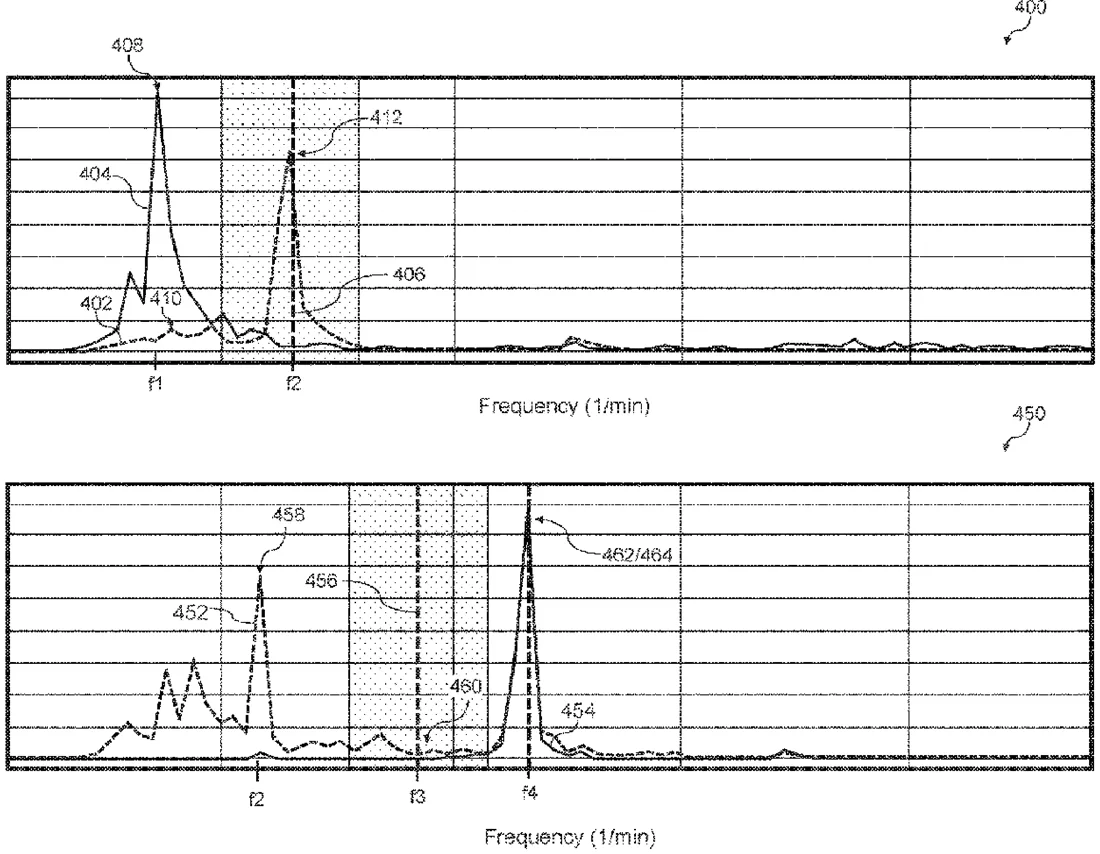
This patent describes a method for wearable devices to improve the accuracy of optical sensors, such as those used for heart rate monitoring. By comparing data from motion sensors (accelerometers) with light sensor readings, the device identifies and filters out signal noise caused by the user's movement. It then adjusts the brightness of the light emitters to ensure the sensor captures a clear, reliable signal despite the motion.
In the filing’s own words
A wearable computing device and system are provided. The wearable computing device includes a display device, an inertial measurement unit (IMU), an optical sensor(s), and a processor(s). The processor(s) is configured to obtain optical sensor data associated with a user of the wearable computing device, obtain movement data characterizing motion of the user, process the optical sensor data and the movement data to identify a motion-induced spurious component of the optical sensor data, and modify an operation mode of the wearable computing device based on the motion-induced spurious component of the optical sensor data.
What exactly they claim (claim 1)
1. A method, comprising: obtaining, via at least one optical sensor of a wearable computing device, optical sensor data associated with a user of the wearable computing device, the at least one optical sensor comprising one or more light emitters; obtaining, via the wearable computing device, movement data characterizing a motion of the user; processing, via the wearable computing device, the optical sensor data and the movement data to identify a motion-induced spurious component of the optical sensor data; and modifying, via the wearable computing device, an operation mode of the wearable computing device based on the motion-induced spurious component of the optical sensor data by: determining, via the wearable computing device, a current transfer ratio (CTR) for the user based on a signal-to-motion ratio (SMR) for the optical sensor data, the SMR being a ratio between the optical sensor data and the movement data at a particular frequency corresponding to a frequency of the motion-induced spurious component; determining, via the wearable computing device, a target signal strength for the at least one optical sensor based on the CTR; and configuring, via the wearable computing device, the one or more light emitters of the at least one optical sensor to emit adjusted optical signals having the target signal strength.
Facts
- Company
- Google (Google LLC)
- Official title
- Optical signal-quality control with accelerometer-induced signals
- Patent number
- US12745963B2
- Application number
- 18980613
- Filed
- Dec 13, 2024
- Granted
- Sep 29, 2026
- Inventors
- 2
- Claims
- 18
Classified under
A61B 5/721 Human necessitiesA61B 5/02416 Human necessitiesA61B 5/02438 Human necessitiesA61B 5/681 Human necessitiesA61B 5/7246 Human necessitiesA61B 5/7257 Human necessitiesMore from Google in Wearables
- Google patents earbuds that verify identity using ultrasound in the ear canal Oct 6, 2026
- Google patents wristband that reads hand gestures from blood flow Oct 13, 2026
- Google patents earbuds that detect jaw movement to switch modes Sep 8, 2026
- Google patents smartwatch guide for pointing your arm at satellites Sep 10, 2026
- Google patents smartwatch feature that warns you if you're too groggy to walk safely Oct 1, 2026
Summaries are simplified from the filing’s own abstract and first claim. A patent filing is not a product announcement.
Patent data and drawings: U.S. Patent and Trademark Office (USPTO). Nebula is not affiliated with or endorsed by the USPTO.