Apple patents way for devices to sync in crowded unlicensed radio bands
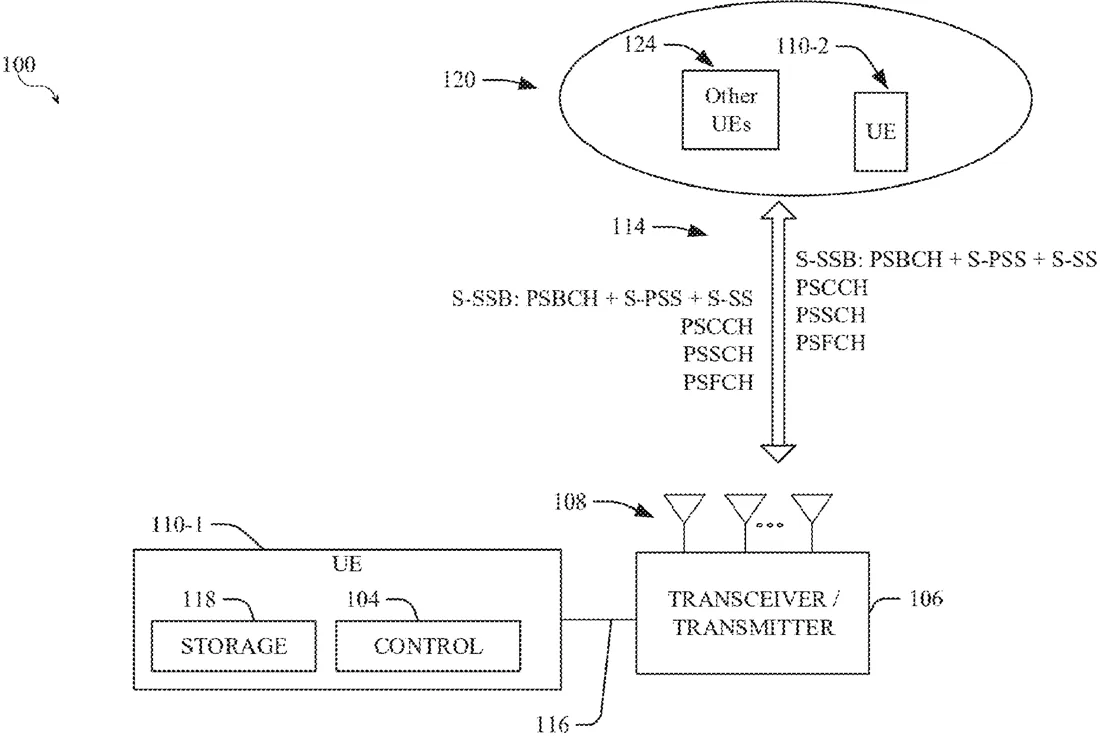
Apple describes a method for devices to send synchronization signals in unlicensed radio frequencies, which are shared by many different technologies. The system adds extra data blocks to the signal to meet specific rules about how much of the channel is already being used by other devices.
In the filing’s own words
A user equipment (UE) can operate in an unlicensed network for sidelink (SL) communications to generate a sidelink (SL) synchronization signal block (S-SSB) transmission in a new radio (NR) unlicensed band, wherein at least one physical resource block (PRB) can be added to satisfy a temporary exemption of an occupied channel bandwidth (OCB). The UE can transmit the S-SSB transmission in an SL channel of the unlicensed band.
What exactly they claim (claim 1)
1. A User Equipment (UE) comprising: a memory; processing circuitry, coupled to the memory, configured to, when executing instructions stored in the memory, cause the UE to: generate a sidelink synchronization signal block (S-SSB) in an unlicensed band; and transmit the S-SSB in a sidelink channel of the unlicensed band.
Facts
- Company
- Apple (Apple Inc.)
- Official title
- PHYSICAL CHANNEL STRUCTURE FOR SIDELINK (SL) IN UNLICENSED SPECTRUM
- Publication number
- US20260333392A1
- Application number
- 19112290
- Filed
- Sep 23, 2022
- Published
- Oct 22, 2026
- Inventors
- 10
- Claims
- 21
Classified under
H04W 72/25 Electricity & electronicsH04B 17/328 Electricity & electronicsMore from Apple in Networks & wireless
- Apple patents interface for sending messages via satellite Sep 29, 2026
- Apple patents way for phones to switch from ground towers to satellites Sep 17, 2026
- Apple patents moving phone plans between devices via Bluetooth Sep 1, 2026
- Apple patents sharing Wi-Fi channel data to speed up device connections Sep 1, 2026
- Apple patents smart surface that helps phones find signal faster Sep 8, 2026
Summaries are simplified from the filing’s own abstract and first claim. A patent filing is not a product announcement.
Patent data and drawings: U.S. Patent and Trademark Office (USPTO). Nebula is not affiliated with or endorsed by the USPTO.