Apple patents showing body parts when people hide behind objects in shared views
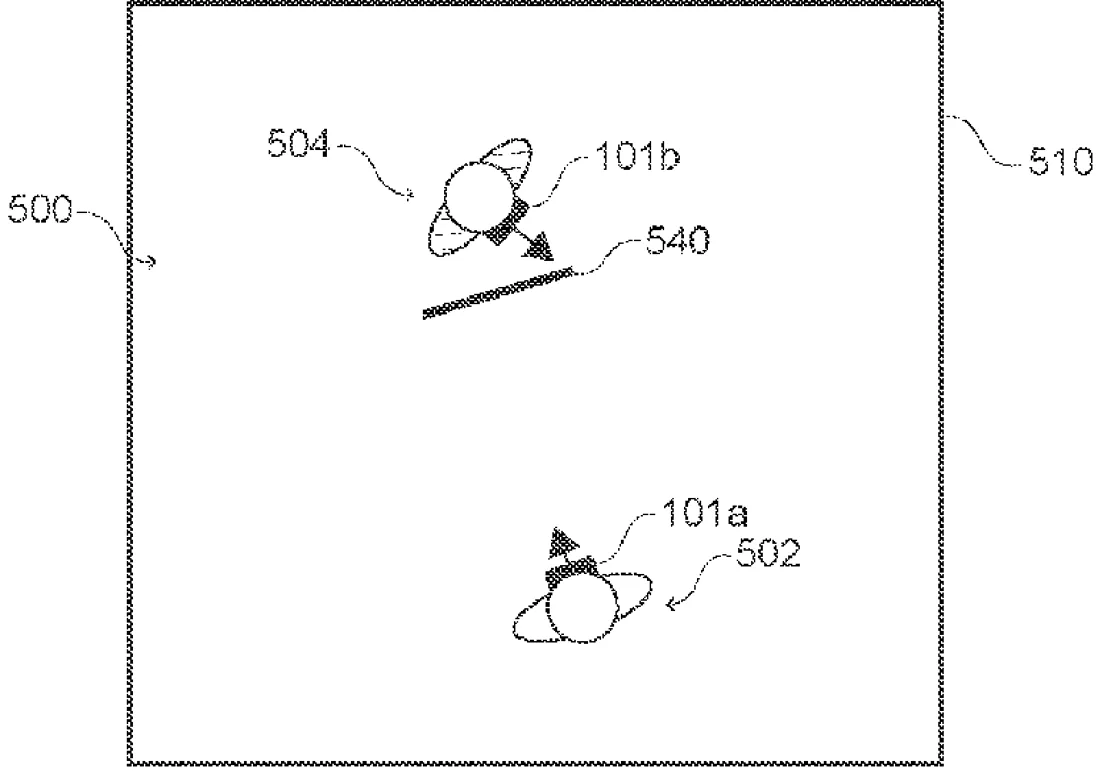
Apple describes a system that tracks the position of a person's body using skeletal data during a shared digital session. If a person moves behind an object in the physical room, the system displays a visual representation of their hidden body parts in the digital view.
In the filing’s own words
Some examples of the disclosure are directed to systems and methods for displaying a virtual object within a multi-user communication session based on skeletal data associated with one or more participants in the multi-user communication session. Some examples of the disclosure are directed to systems and methods for displaying a visual indication of a participant within a multi-user communication session based on skeletal data associated with the participant in the multi-user communication session. In some examples, while a first electronic device is in a communication session with a second electronic device that is collocated with the first electronic device in a physical environment, the first electronic device receives first data provided by the second electronic device that includes skeletal data associated with a user of the second electronic device.
What exactly they claim (claim 1)
1. A method comprising: at a first electronic device in communication with one or more displays and one or more input devices, wherein the first electronic device is collocated with a second electronic device in a first physical environment: while the first electronic device is in a communication session with the second electronic device, receiving first data provided by the second electronic device that includes skeletal data associated with a user of the second electronic device; after receiving the first data, detecting movement of the user of the second electronic device in the first physical environment; and in response to detecting the movement of the user of the second electronic device: in accordance with a determination that the movement of the user of the second electronic device causes at least a portion of the user of the second electronic device to be occluded by at least a portion of the first physical environment relative to a viewpoint of the first electronic device, displaying, via the one or more displays, a visual indication corresponding to the at least the portion of the user of the second electronic device at a location in a three-dimensional environment corresponding to the at least the portion of the first physical environment based on the first data.
Facts
- Company
- Apple (Apple Inc.)
- Official title
- SKELETAL DATA TRACKING OF PARTICIPANTS IN MULTI-USER COMMUNICATION SESSIONS
- Publication number
- US20260330773A1
- Application number
- 19723744
- Filed
- Jun 29, 2026
- Published
- Oct 22, 2026
- Inventors
- 3
- Claims
- 24
Classified under
G06T 19/00 Physics & computingG06F 3/012 Physics & computingG06F 3/1454 Physics & computingG06T 7/70 Physics & computingG06T 15/20 Physics & computingG06T 2200/24 Physics & computingMore from Apple in AR, VR & displays
- Apple patents AR glasses that zoom in on what you look at Sep 8, 2026
- Apple patents finger ring that controls VR with taps and waves Sep 15, 2026
- Apple patents head-mounted device that types via eye swipes and hand pinches Oct 6, 2026
- Apple patents eye-tracking and hand gestures to select screen items Oct 20, 2026
- Apple patents AR glasses that adjust lenses to fit your eyes Sep 17, 2026
Summaries are simplified from the filing’s own abstract and first claim. A patent filing is not a product announcement.
Patent data and drawings: U.S. Patent and Trademark Office (USPTO). Nebula is not affiliated with or endorsed by the USPTO.