Microsoft patents modular engine for organizing and analyzing sensitive data
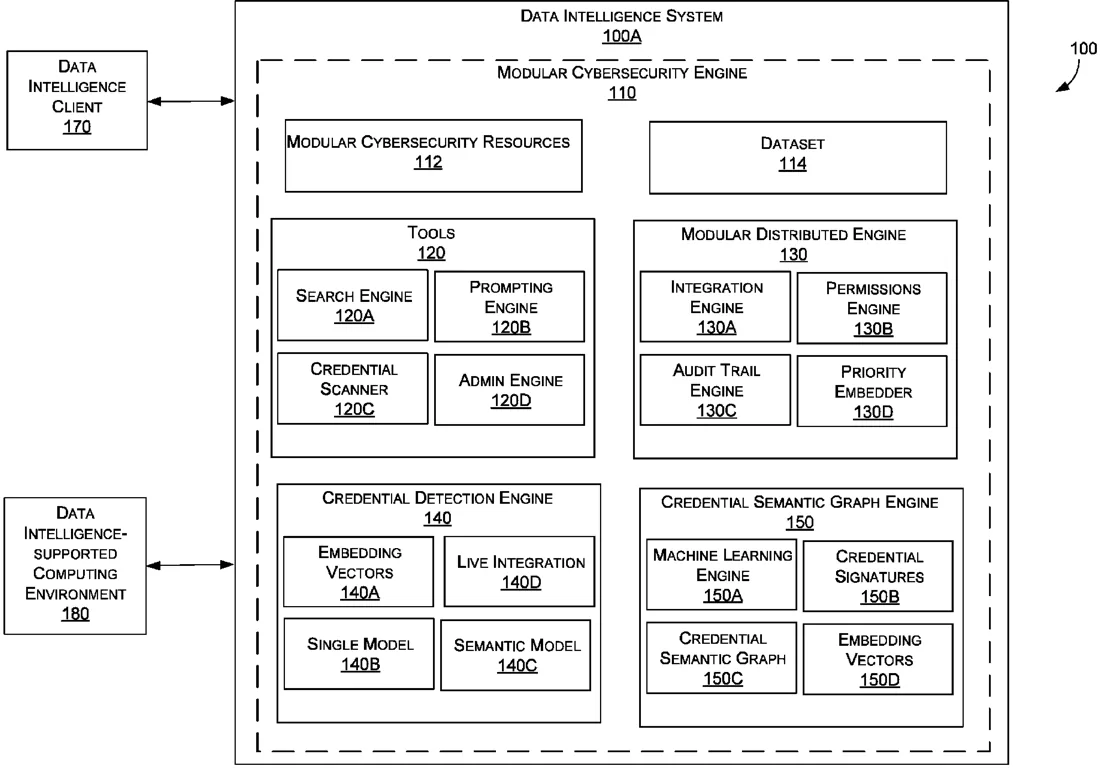
Microsoft describes a cybersecurity system that uses a modular engine to manage and analyze large datasets. It works by assigning priority values to different pieces of data, removing duplicates, and converting the most important items into mathematical formats called embedding vectors for faster analysis.
In the filing’s own words
Methods, systems, and computer storage media for providing a modular cybersecurity platform are described. The modular cybersecurity platform is implemented using a modular cybersecurity engine that operates based on an analytical framework for dynamic data analysis and data management in a data intelligence system. In particular, the analytical framework is based on complementary modular components that are designed to interoperate in the modular cybersecurity engine. The modular cybersecurity engine includes a modular distributed system, a credential detection system, and a credential semantic graph system. The modular cybersecurity engine supports cybersecurity and sensitive data management scenarios that can empower investigators in various investigations, and provide automated flows that are highly scalable and support different types of functionality (e.g., priority embedding pipeline, credential scanning, and credential semantic graph analysis). The utility of the modular cybersecurity engine is demonstrated by its wide-ranging application in addressing complex cybersecurity challenges and sensitive data management tasks.
What exactly they claim (claim 1)
1. A computerized system comprising: one or more computer processors; and computer memory storing computer-useable instructions that, when used by the one or more computer processors, cause the one or more computer processors to perform operations, the operations comprising: accessing, at a priority embedder pipeline, a dataset comprising a plurality of data items, the plurality of data items comprising a first data item and a second data item; assigning corresponding priority values to a first set of content instances in the first data item; identifying a first set of unique content instances in the first data item based on de-duplicating the first set of content instances based on the corresponding priority values and identified matching content instances in the first set of content instances; assigning corresponding priority values to a second set of content instances in the second data item; identifying a second set of unique content instances in the second data item based on de-duplicating the second set of content instances based on the corresponding priority values and identified matching content instances in the second set of content instances; identifying a third set of unique content instances in the first data item and the second data item based on de-duplicating the first set of unique content instances and the second set of unique content instances based on the corresponding priority values and identified matching content instances in the first set of unique content instances and the second set of unique content instances; and generating embedding vectors for the third set of unique content instances, wherein the third set of unique content instances are higher-priority content instances identified for vector embedding priority in the priority embedder pipeline.
Facts
- Company
- Microsoft (Microsoft Technology Licensing, LLC)
- Official title
- MODULAR CYBERSECURITY ENGINE IN A DATA INTELLIGENCE SYSTEM
- Publication number
- US20260330049A1
- Application number
- 19724022
- Filed
- Jun 29, 2026
- Published
- Oct 22, 2026
- Inventors
- 4
- Claims
- 20
Classified under
G06F 21/6218 Physics & computingMore from Microsoft in Security & privacy
- Microsoft patents system to call 911 for others during video calls Sep 22, 2026
- Microsoft patents system to block fake code suggested by AI Sep 15, 2026
- Microsoft patents one-way data flow to block network attacks Sep 10, 2026
- Microsoft patents voice coding that hides speaker identity for secure calls Sep 17, 2026
- Microsoft patents security checks for AI chats using user and model profiles Oct 1, 2026
Summaries are simplified from the filing’s own abstract and first claim. A patent filing is not a product announcement.
Patent data and drawings: U.S. Patent and Trademark Office (USPTO). Nebula is not affiliated with or endorsed by the USPTO.