Google patents AR glasses tech that squeezes light to save battery
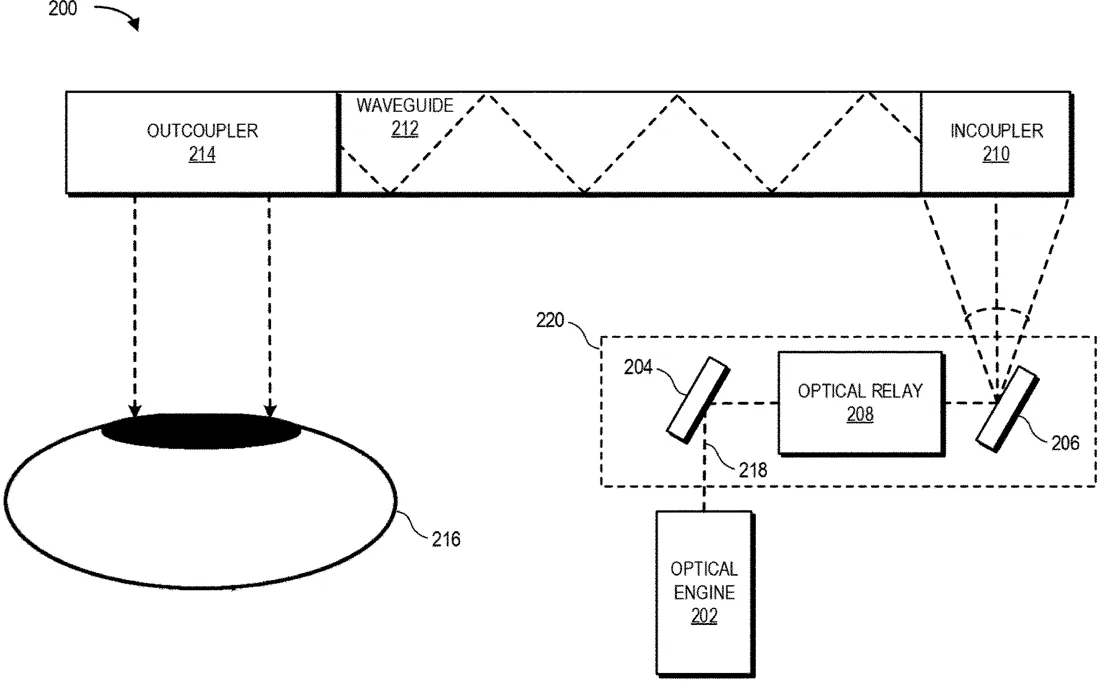
This filing describes a method for improving the efficiency of light entry in augmented reality headsets. It uses specific optical components to manipulate the polarization of light, allowing more of it to enter the display waveguide without wasting energy. This process aims to reduce the power needed to drive the display.
In the filing’s own words
Embodiments disclosed variously address the etendue limit on incoupling, e.g., in an augmented or mixed reality display waveguide combiner, by trading polarization state purity for reduced space-bandwidth product using a combination of optical elements, thereby improving system efficiency, reducing power constraints, and thus enabling longer battery life and/or smaller battery size. Efficiency of optical systems such as head mounted display devices can thus be increased to allow for lighter weight devices and/or devices that require fewer charges between uses.
What exactly they claim (claim 1)
1. A head mounted display (HMD) device comprising: a light source; a first optical element configured to convert a polarization state of light from the light source; a second optical element configured to selectively reflect or transmit light transmitted by the first optical element based on a polarization state of the light transmitted by the first optical element; and a first incoupler configured to direct light transmitted by the second optical element into a waveguide, wherein the first optical element is further configured to convert a polarization state of light directed into the waveguide by the first incoupler such that the light directed into the waveguide by the first incoupler is selectively reflected by the second optical element.
Facts
- Company
- Google (GOOGLE LLC)
- Official title
- ENTENDUE SQUEEZING IN OPTICAL SYSTEMS
- Publication number
- US20260329103A1
- Application number
- 19111226
- Filed
- Sep 15, 2022
- Published
- Oct 22, 2026
- Inventors
- 1
- Claims
- 20
Classified under
G02B 27/286 Physics & computingG02B 6/4202 Physics & computingG02B 27/0172 Physics & computingG02B 5/3058 Physics & computingG02B 2027/0178 Physics & computingMore from Google in AR, VR & displays
- Google patents video conference stage with built-in teleprompter Sep 15, 2026
- Google patents VR headset that checks your eyesight Oct 20, 2026
- Google patents glasses that share one lens for cameras and projectors Oct 20, 2026
- Google patents AR glasses with two separate screens in one lens Oct 1, 2026
- Google patents AR glasses that switch light paths to widen the view Oct 8, 2026
Summaries are simplified from the filing’s own abstract and first claim. A patent filing is not a product announcement.
Patent data and drawings: U.S. Patent and Trademark Office (USPTO). Nebula is not affiliated with or endorsed by the USPTO.