Microsoft patents method to sort cells using random rules
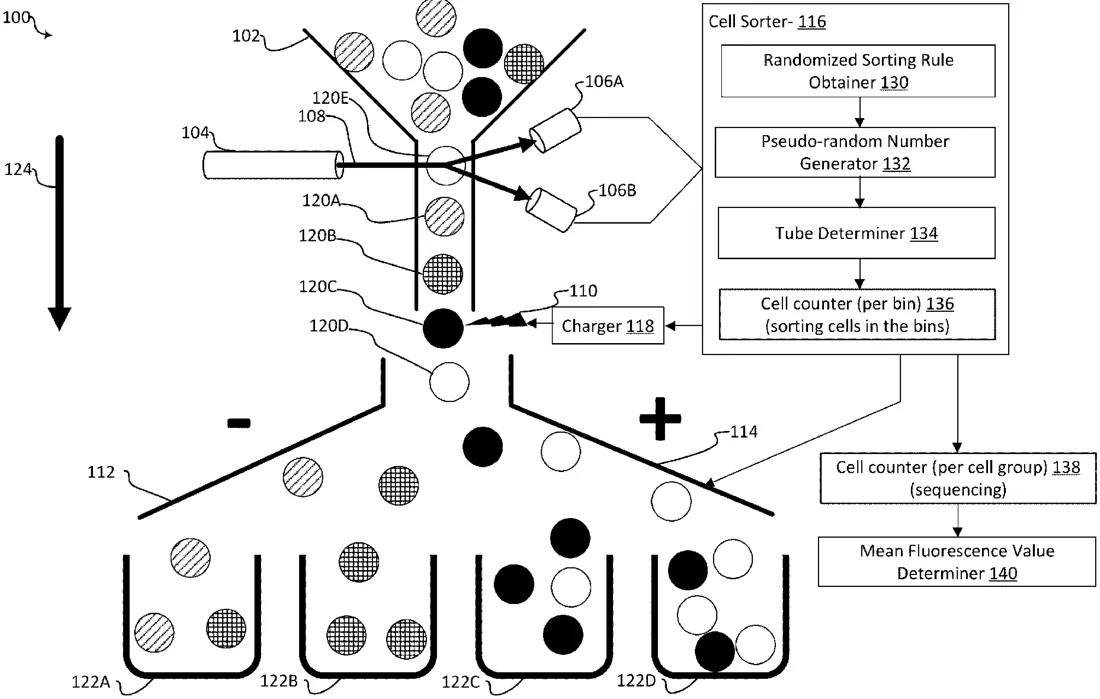
Microsoft describes a computer-based method for sorting biological cells into different containers based on how much light they emit. Instead of using fixed brightness ranges, the system uses random numbers to decide where each cell goes, which helps calculate the average brightness of specific cell types more accurately.
In the filing’s own words
Systems and methods are provided for sorting cells with distinct cell designs for characterizing a library of the cell designs. The present disclosure uses randomized sorting rules associated with bins and pseudo-random numbers to counts the cells with measured fluorescence values in one of the bins. A mean fluorescence value for a cell design group may be determined based on a ratio of cell counts of the cells associated with the cell design group across the bins. Unlike the traditional histogram-based sorting that use a mean fluorescence value of a bin, the disclosed technology determines mean fluorescence values of cell design groups for characterizing libraries of the cell design group. Use of the mean fluorescence values with unbiased “sort-seq” and a de-multiplexed sequencing using the mean fluorescence values enables characterizing libraries of cell designs with improved accuracy over traditional use of discrete histograms.
What exactly they claim (claim 1)
1. A computer-implemented method for determining a mean fluorescence value for a cell design group, the method comprising: retrieving randomized sorting rules for sorting a cell into one of a plurality of containers, wherein each randomized sorting rule corresponds to each container of the plurality of containers, and wherein the randomized sorting rules include one or more probability values corresponding to a fluorescence value; receiving a measured fluorescence value associated with a cell, wherein the measured fluorescence value corresponds to a light emission of the cell; generating a number for the cell, wherein the number includes either a random number or a pseudo-random number; determining one of the plurality of containers into which the cell is sorted based on a combination of the number and the one or more probability values; determining, based on sequencing of cells including the cell in a container of the plurality of containers, cell counts of the cell design groups across the plurality of containers; and determining, based on a model using the cell counts of the cell design groups across the plurality of containers, a value corresponding to the cell design group.
Facts
- Company
- Microsoft (Microsoft Technology Licensing, LLC)
- Official title
- UNBIASED SORTING AND SEQUENCING OF OBJECTS VIA RANDOMIZED GATING SCHEMES
- Publication number
- US20260328687A1
- Application number
- 19531350
- Filed
- Feb 5, 2026
- Published
- Oct 22, 2026
- Inventors
- 4
- Claims
- 20
Classified under
G01N 21/6428 Physics & computingG01N 21/6458 Physics & computingG16B 30/00 Physics & computingG01N 2021/6439 Physics & computingMore from Microsoft in Health & body
- Microsoft patents 3D video system to suggest health-related gestures Oct 20, 2026
- Microsoft patents system to compress and link different types of health data Sep 10, 2026
Summaries are simplified from the filing’s own abstract and first claim. A patent filing is not a product announcement.
Patent data and drawings: U.S. Patent and Trademark Office (USPTO). Nebula is not affiliated with or endorsed by the USPTO.