Google patents low-power electrode to detect presence and heart rate
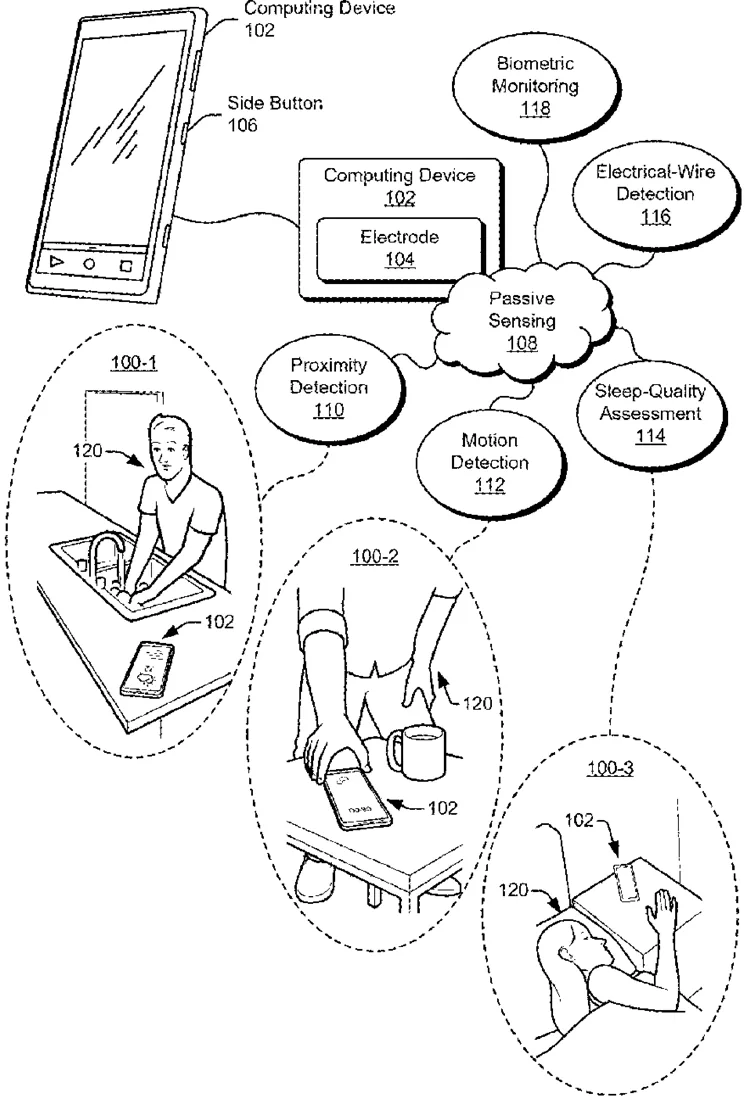
Google describes a method where a device uses a simple electrode to passively sense changes in the surrounding electric field. This allows the device to detect if a body is nearby without using active sensors like cameras or lasers. The filing also notes that the same electrode can measure heart rate when a finger or hand is placed on the device.
In the filing’s own words
Techniques and apparatuses are described that implement passive proximity detection using an electrode. In example aspects, a computing device includes at least one electrode, which is capable of passively sensing an electric field in an external environment. By using the electrode to detect changes in the electric field, the computing device can perform proximity detection to detect the presence (or absence) of a body. This form of proximity detection can consume significantly less power compared to other active sensing techniques. The electrode can also be cheaper and/or have a smaller footprint compared to other types of sensors. Other advantages of the electrode include it being orientation agnostic, able to operate in all lighting conditions, and capable of penetrating obstructions. With the use of the electrode, proximity detection can be performed while preserving the privacy of a user.
What exactly they claim (claim 1)
1. A method performed by a computing device, the method comprising: passively sensing, during a first time and using at least one electrode of the computing device, an electric field that exists within an external environment; detecting, based on the passive sensing, a change in the electric field; detecting from the change in the electric field that a body is present within a proximity range from the computing device; and measuring, during a second time and using the at least one electrode, a heart rate from a human appendage placed over a portion of the computing device that includes the at least one electrode.
Facts
- Company
- Google (Google LLC)
- Official title
- Passive Proximity Detection using an Electrode
- Publication number
- US20260324988A1
- Application number
- 19117379
- Filed
- Sep 30, 2024
- Published
- Oct 22, 2026
- Inventors
- 6
- Claims
- 20
Classified under
A61B 5/0205 Human necessitiesA61B 5/02438 Human necessitiesA61B 5/1126 Human necessitiesA61B 5/332 Human necessitiesA61B 5/4815 Human necessitiesA61B 5/6898 Human necessitiesMore from Google in Health & body
- Google patents using phone cameras to measure heart and breathing rates Sep 15, 2026
- Google patents eye scan that spots diabetes from front-of-eye photos Sep 15, 2026
- Google patents system to spot surgical errors in video Sep 3, 2026
- Google patents phone sensor that measures blood pressure from a fingertip Sep 17, 2026
- Google patents radar and wearable tech for non-invasive blood pressure checks Sep 24, 2026
Summaries are simplified from the filing’s own abstract and first claim. A patent filing is not a product announcement.
Patent data and drawings: U.S. Patent and Trademark Office (USPTO). Nebula is not affiliated with or endorsed by the USPTO.