Microsoft patents way for old devices to get quantum-proof security
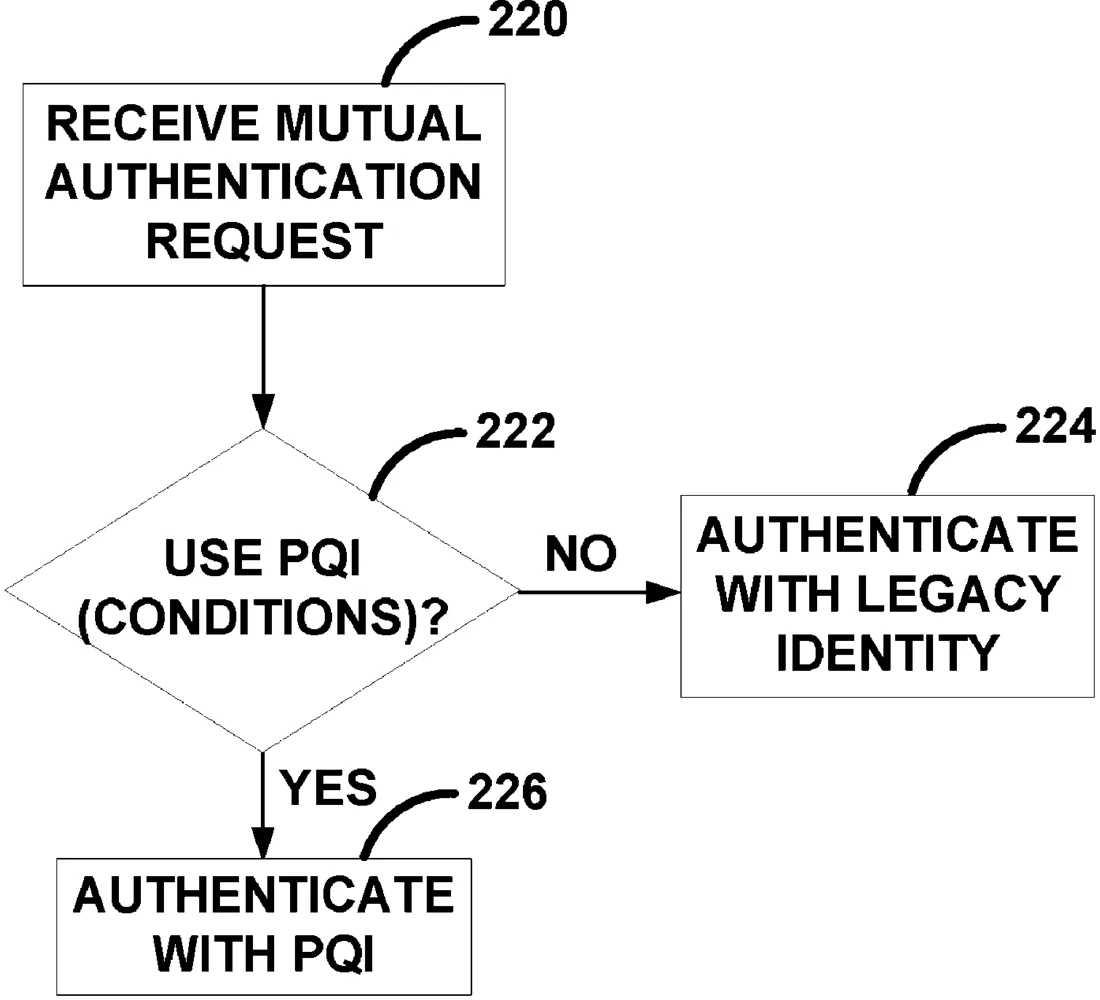
This filing describes a method where a device first connects to a server using its current, standard security identity. It then downloads a software update that gives it a new, separate identity designed to resist attacks from future quantum computers. Once updated, the device uses this new identity to securely talk to a different server.
In the filing’s own words
Devices, systems, and methods for post-quantum (PQ) secure (PQS) communications are provided. A method includes authenticating, by a device and with a first server, using a legacy device identity, receiving and installing, by the device, a firmware upgrade that provides the device an ability to communicate in a PQS manner, establishing a PQS communication channel between the device and a second server, mutually authenticating, by the device and with the second server, using a PQ identity (PQI) of the device, the PQI different from the legacy identity, and responsive to successful mutual authentication, communicating between the device and the second server, using the PQS communication channel.
What exactly they claim (claim 1)
1. A method comprising: authenticating, by a device and with a first server, using a legacy device identity; receiving and installing, by the device, a firmware upgrade that provides the device an ability to communicate in a post-quantum (PQ) secure (PQS) manner; establishing a PQS communication channel between the device and a second server; mutually authenticating, by the device and with the second server, using a PQ identity (PQI) of the device, the PQI different from the legacy identity; and responsive to successful mutual authentication, communicating between the device and the second server, using the PQS communication channel.
Facts
- Company
- Microsoft (Microsoft Technology Licensing, LLC)
- Official title
- POST-QUANTUM SAFE MUTUAL AUTHENTICATION COMMUNICATION SYSTEMS
- Publication number
- US20260322594A1
- Application number
- 19178615
- Filed
- Apr 14, 2025
- Published
- Oct 15, 2026
- Inventors
- 3
- Claims
- 20
Classified under
H04L 9/0852 Electricity & electronicsH04L 9/3273 Electricity & electronicsG06F 21/445 Physics & computingG06F 21/606 Physics & computingMore from Microsoft in Security & privacy
- Microsoft patents system to call 911 for others during video calls Sep 22, 2026
- Microsoft patents system to block fake code suggested by AI Sep 15, 2026
- Microsoft patents one-way data flow to block network attacks Sep 10, 2026
- Microsoft patents voice coding that hides speaker identity for secure calls Sep 17, 2026
- Microsoft patents security checks for AI chats using user and model profiles Oct 1, 2026
Summaries are simplified from the filing’s own abstract and first claim. A patent filing is not a product announcement.
Patent data and drawings: U.S. Patent and Trademark Office (USPTO). Nebula is not affiliated with or endorsed by the USPTO.