Nvidia patents visual word lists to help robots find their way
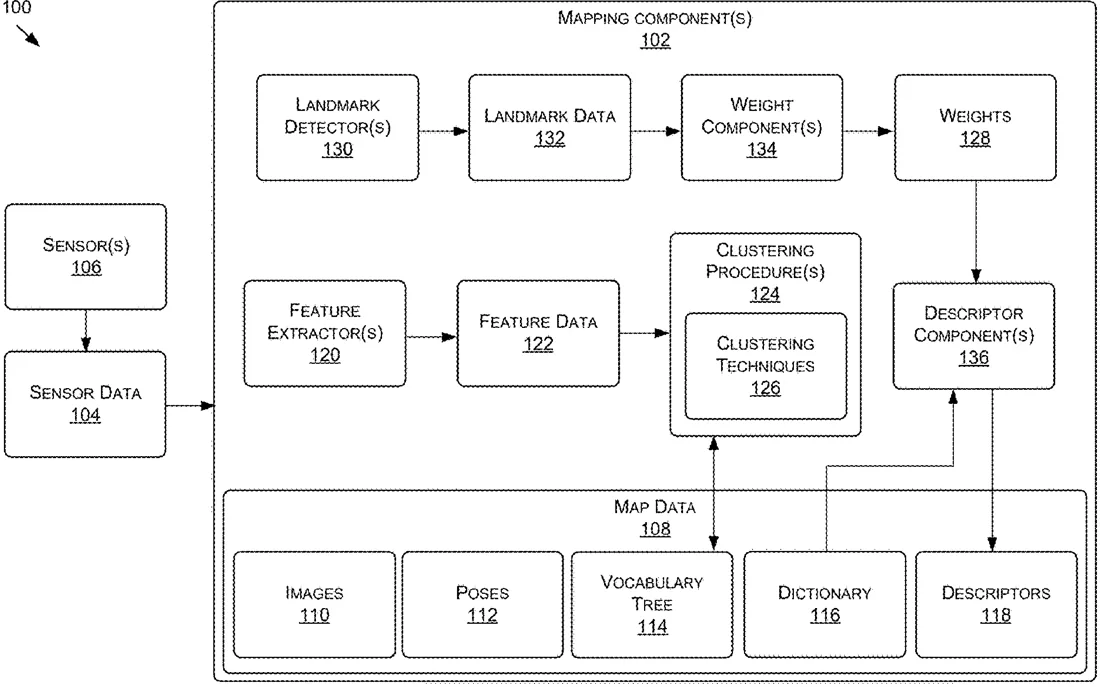
Nvidia describes a method for creating a 'vocabulary dictionary' that helps autonomous machines locate themselves in an environment. The system uses clustering algorithms to turn images into a tree of visual words, which it updates as new images are captured to keep the map accurate.
In the filing’s own words
In various examples, techniques for generating vocabulary dictionary for localization in autonomous and/or semi-autonomous systems and applications are described herein. Systems and methods may use multiple clustering techniques—such as K-Means Clustering and/or Balanced Iterative Reducing and Clustering using Hierarchies (BIRCH)—to initially generate and/or update a vocabulary dictionary corresponding to an environment. For instance, using the clustering techniques, extracted features from initial images of a localization map may be used to generate a vocabulary tree corresponding to the vocabulary dictionary. Additionally, and again using the clustering techniques, extracted features from new images of the localization map may be used to update the vocabulary tree. In some examples, the systems and methods may further determine weights associated with the visual words, such as with algorithms that are optimized for indoor environments where multiple images may capture similar portions of the environment from similar poses.
What exactly they claim (claim 1)
1. A method comprising: determining one or more first features associated with one or more first images corresponding to a localization map of an environment; generating, based at least on clustering the one or more first features using a first clustering technique, a vocabulary tree that represents one or more first visual words associated with the environment; determining one or more second features associated with one or more second images corresponding to the localization map; updating, based at least on the one or more second features and using a second clustering technique, the vocabulary tree to represent one or more second visual words associated with the environment; and providing, to one or more machines, data representative of at least one of the vocabulary tree or a vocabulary dictionary associated with the vocabulary tree, the data for performing localization of the one or more machines within the environment.
Facts
- Company
- Nvidia (NVIDIA Corporation)
- Official title
- GENERATING VOCABULARY DICTIONARIES FOR LOCALIZATION IN AUTONOMOUS AND SEMI-AUTONOMOUS SYSTEMS AND APPLICATIONS
- Publication number
- US20260321040A1
- Application number
- 19174716
- Filed
- Apr 9, 2025
- Published
- Oct 15, 2026
- Inventors
- 5
- Claims
- 20
Classified under
G06V 20/70 Physics & computingG06F 40/242 Physics & computingG06V 10/762 Physics & computingMore from Nvidia in AI & software
- Nvidia patents AI coach that analyzes your gameplay to suggest strategies Oct 13, 2026
- Nvidia patents AI system that writes and voices character conversations Sep 10, 2026
- Nvidia patents system that uses AI to find bugs in game videos Sep 17, 2026
- Nvidia patents AI method to make digital characters move realistically Sep 8, 2026
- Nvidia patents AI system that builds image generators from text prompts Sep 15, 2026
Summaries are simplified from the filing’s own abstract and first claim. A patent filing is not a product announcement.
Patent data and drawings: U.S. Patent and Trademark Office (USPTO). Nebula is not affiliated with or endorsed by the USPTO.