Samsung patents AR glasses that blend real and virtual objects
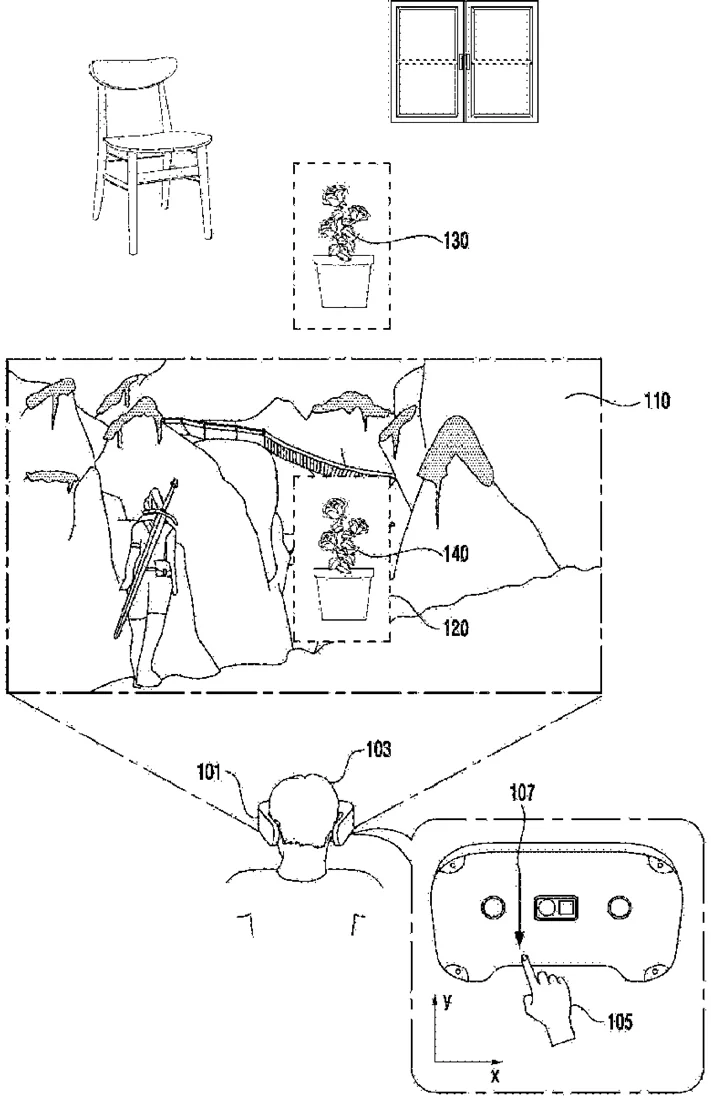
This filing describes a head-wearable device that uses a camera to detect real-world objects and displays them alongside virtual content. When a user interacts with a virtual item, the device gradually changes how the real object appears, shifting its visual effect to blend it into the virtual scene.
In the filing’s own words
According to an example embodiment, a processor of a wearable device displays a virtual object superimposed on a virtual space by using a display. The processor receives an input for rotating a dial in a first direction while the superimposed virtual object is displayed in the virtual space. While the input is maintained, the processor reduces a first area in which the virtual space is displayed. While the input is maintained, the processor maintains a size of the virtual object that is superimposed on the virtual space and is displayed inside of the first area reduced while the input is maintained. While the input is maintained, the processor expands a second area including the image that is further displayed on the display in response to the input.
What exactly they claim (claim 1)
1. A head-wearable electronic device comprising: at least one camera; at least one display; memory including one or more storage media storing instructions; and at least one processor including processing circuitry, wherein the instructions, when executed by the at least one processor individually or collectively, cause the head-wearable electronic device to: display a virtual environment via the at least one display; identify a visual object from an image obtained via the at least one camera while the virtual environment is displayed; based on identifying the visual object, display the visual object, wherein the visual object is displayed as being viewed to be overlapped with the portion of the virtual environment in accordance with a first visual effect; while the visual object and the portion of the virtual environment are concurrently viewed via the at least one display, identify a user input with respect to the visual object; and based on the user input, gradually change a visual effect used for displaying the visual object from the first visual effect to a second visual effect.
Facts
- Company
- Samsung (Samsung Electronics Co., Ltd.)
- Official title
- WEARABLE DEVICE FOR IDENTIFYING AREA FOR DISPLAYING IMAGE AND METHOD THEREOF
- Publication number
- US20260320945A1
- Application number
- 19466312
- Filed
- Jan 31, 2026
- Published
- Oct 15, 2026
- Inventors
- 7
- Claims
- 20
Classified under
G06T 19/20 Physics & computingG06F 3/011 Physics & computingG06F 3/02 Physics & computingG06F 3/0362 Physics & computingG06T 7/20 Physics & computingG06T 19/006 Physics & computingMore from Samsung in AR, VR & displays
- Samsung patents screen that predicts where your eyes will look next Sep 29, 2026
- Samsung patents AR headset that adjusts images using eye tracking Sep 17, 2026
- Samsung patents camera feature that identifies objects and shows AR info Sep 17, 2026
- Samsung patents method to animate avatars from photos and voice Sep 24, 2026
- Samsung patents AR glasses that blend real objects into virtual scenes Oct 1, 2026
Summaries are simplified from the filing’s own abstract and first claim. A patent filing is not a product announcement.
Patent data and drawings: U.S. Patent and Trademark Office (USPTO). Nebula is not affiliated with or endorsed by the USPTO.