Nvidia patents method to generate complex traffic scenarios for self-driving training
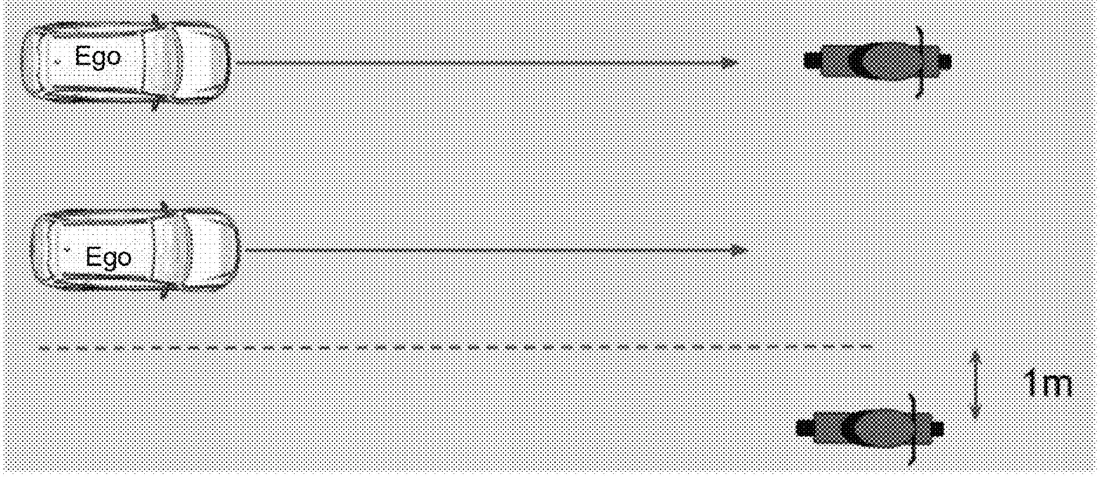
Nvidia describes a method for creating detailed driving scenarios by analyzing the movement of a self-driving vehicle and other road users like cars or pedestrians. The system tracks speed, acceleration, and distance between these vehicles to identify specific interactions, such as when one vehicle blocks the view of another. These generated scenarios help train machine learning systems to handle tricky situations like occlusions where objects are hidden from view.
In the filing’s own words
Autonomous and/or semi-autonomous machine performance benefits from learning many different scenarios that a machine (ego machine) may encounter, particularly those relating to other machines (agent machines) encountered in the environment. By tracking the agent machines, varying parameters of relative movement between an ego machine and the agent machines, and varying parameters of surface and weather conditions, and traffic conditions, it is possible to create many more sophisticated scenarios than has been possible with prior approaches, and thus improve the training of one or more machine learning systems on the ego machine. According to different aspects, it is possible to provide traffic scenarios involving occlusions which prevent an ego machine from identifying and being able to react to conditions in the ego machine's path. The conditions may involve pedestrians, bicycles, or one or more agent machines.
What exactly they claim (claim 1)
1. A method comprising: receiving first data describing one or more agent trajectories and one or more agent types of one or more agent machines in an environment, and second data describing an ego trajectory and an ego type of an ego machine in the environment, the first data including speed and acceleration of each of the one or more agent machines, the second data including speed and acceleration of the ego vehicle, one of the first data or second data including a distance of each of the one or more agent machines from the ego machine; defining a scenario that includes at least one interaction between the one or more agent machines and the ego machine in the environment, the at least one interaction including one or more of relative speed, relative distance, or relative acceleration between the ego machine and a respective one of the one or more agent machines; and identifying, based on the first data and the second data, third data that represents the at least one interaction included in the scenario.
Facts
- Company
- Nvidia (NVIDIA Corporation)
- Official title
- TARGET OBJECT AND FEATURE MINING
- Publication number
- US20260316792A1
- Application number
- 19255606
- Filed
- Jun 30, 2025
- Published
- Oct 15, 2026
- Inventors
- 5
- Claims
- 20
Classified under
B60W 60/0027 Operations & transportB60W 2520/125 Operations & transportMore from Nvidia in AI & software
- Nvidia patents AI coach that analyzes your gameplay to suggest strategies Oct 13, 2026
- Nvidia patents AI system that writes and voices character conversations Sep 10, 2026
- Nvidia patents system that uses AI to find bugs in game videos Sep 17, 2026
- Nvidia patents AI method to make digital characters move realistically Sep 8, 2026
- Nvidia patents AI system that builds image generators from text prompts Sep 15, 2026
Summaries are simplified from the filing’s own abstract and first claim. A patent filing is not a product announcement.
Patent data and drawings: U.S. Patent and Trademark Office (USPTO). Nebula is not affiliated with or endorsed by the USPTO.