Tesla patents flexible 3D touch sensors that bend to fit curved surfaces
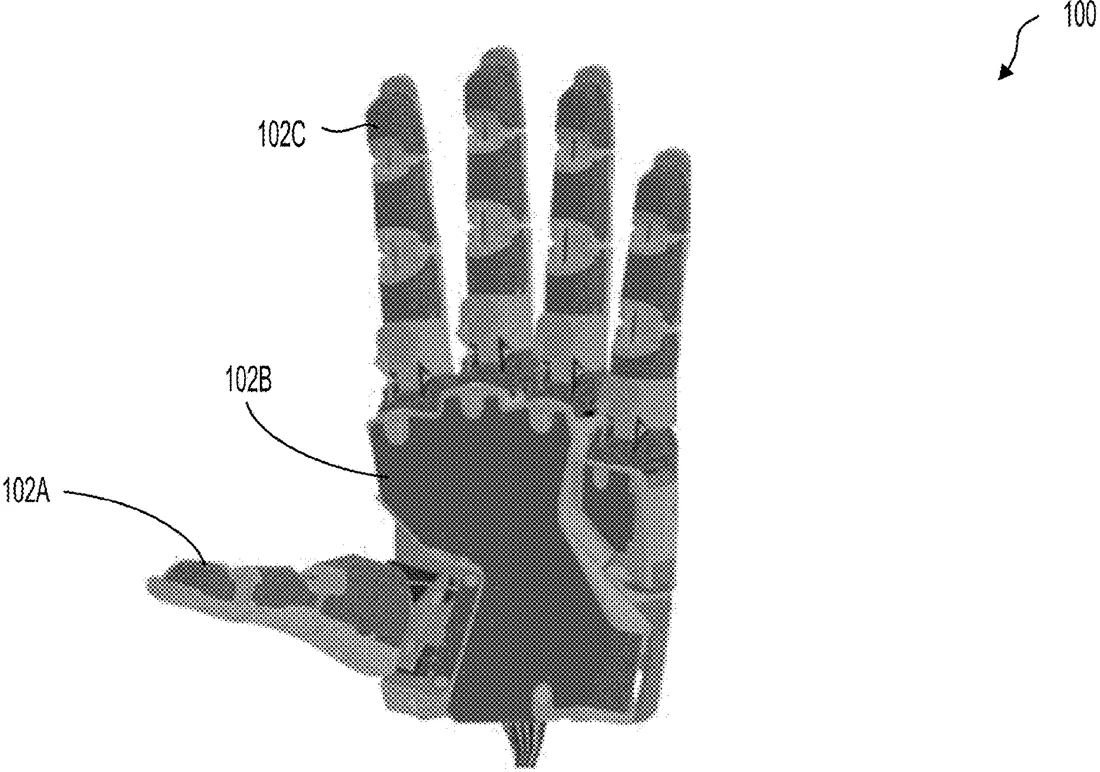
Tesla describes a method for making tactile sensors that can detect touch and pressure while bending into three-dimensional shapes. The device is built by layering flexible materials with conductive patterns and a separator, then molding the stack into a specific curved form.
In the filing’s own words
Disclosed herein are three-dimensional (3D) tactile sensors and methods for manufacturing the same. A method includes providing a first substrate material for the 3D tactile sensor, defining a set of first conductive regions for the 3D tactile sensor on the first substrate material, coupling a separator layer between the first substrate material including the set of first conductive regions and a second substrate material having a set of second conductive regions to create a stack, and forming the stack according to a target 3D structure. The substrate materials can include flexible polymers, and the conductive regions can be defined by processes such as screen printing, etching, laser-direct structuring, pad-printing, or 3D deposition. The separator layer can comprise a dielectric or piezoresistive material. The 3D tactile sensors can conform to curved geometries and can be used for measuring surface force, touch, and pressure.
What exactly they claim (claim 1)
1. A method of forming a three-dimensional (3D) tactile sensor, comprising: providing a first substrate material for the 3D tactile sensor; defining a set of first conductive regions for the 3D tactile sensor on the first substrate material; coupling a separator layer between the first substrate material including the set of first conductive regions and a second substrate material having a set of second conductive regions to create a stack; and forming the stack into a target 3D structure.
Facts
- Company
- Tesla (Tesla, Inc.)
- Official title
- THREE-DIMENSIONAL SOFT COMPLIANT ARRAY TACTILE SENSOR WITH MULTI-MODAL SENSING AND SCALABLE MANUFACTURING METHODS
- Publication number
- US20260310299A1
- Application number
- 19326524
- Filed
- Sep 11, 2025
- Published
- Oct 8, 2026
- Inventors
- 12
- Claims
- 20
Classified under
G06F 3/016 Physics & computingG06F 3/014 Physics & computingG06F 3/0446 Physics & computingG06F 2203/04103 Physics & computingMore from Tesla in Chips & hardware
- Tesla patents method to detect dangerous electrical arcs in vehicle systems Oct 8, 2026
- Tesla patents conductive grease to ground electric drivetrain bearings Sep 22, 2026
- Tesla patents single-wire control for lit buttons and switches Sep 22, 2026
- Tesla patents chip design that picks math tasks based on network position Sep 29, 2026
- Tesla patents cooling plate that slides to fit different chip heights Oct 13, 2026
Summaries are simplified from the filing’s own abstract and first claim. A patent filing is not a product announcement.
Patent data and drawings: U.S. Patent and Trademark Office (USPTO). Nebula is not affiliated with or endorsed by the USPTO.