Google patents anonymous proof of device health without tracking IDs
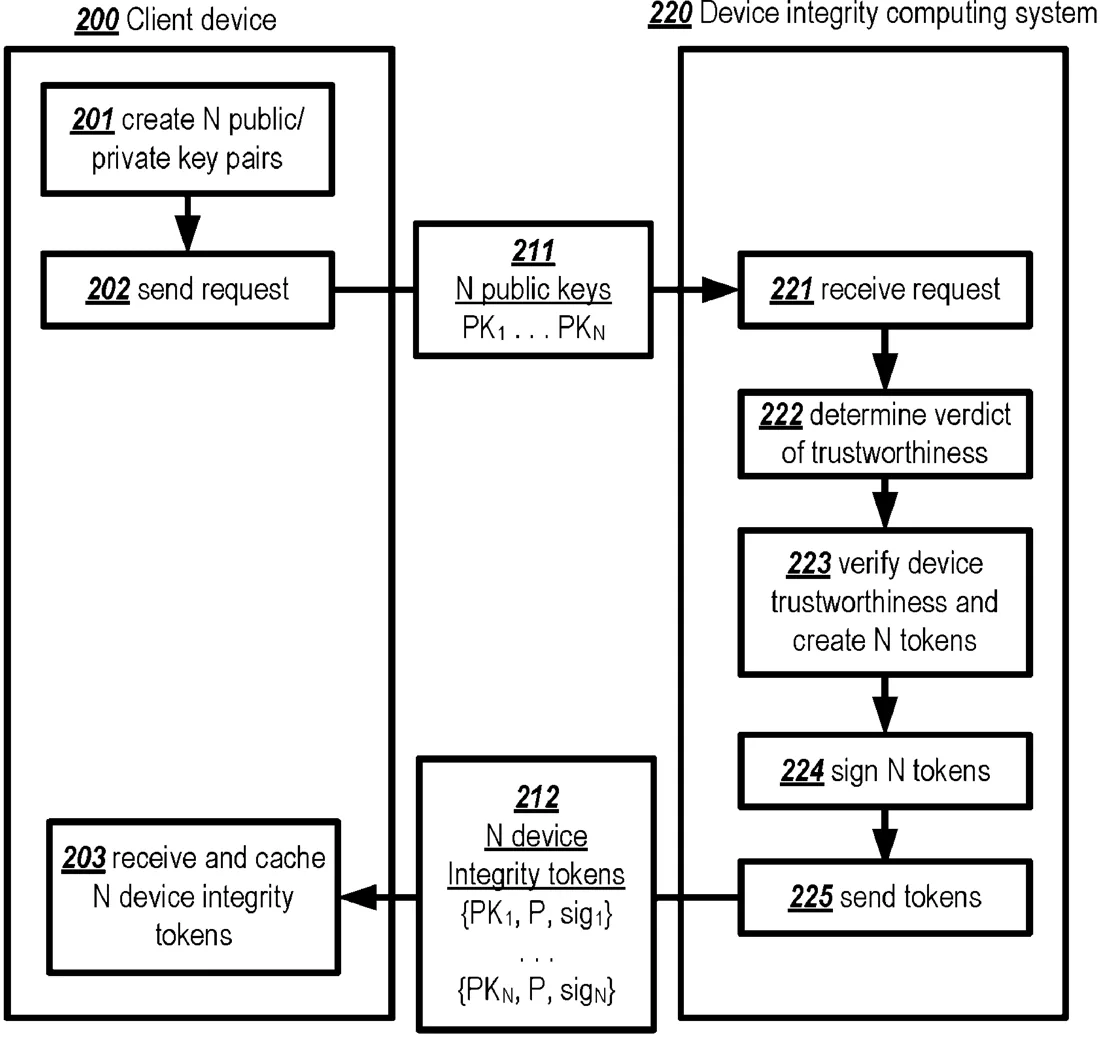
Google has filed a patent for a system that verifies a device is genuine without using a permanent ID that could track the user. The method uses a cryptographic technique called blind signatures to create temporary proof tokens that confirm the device's integrity. These tokens allow servers to trust the connection while keeping the specific device anonymous.
In the filing’s own words
Methods, systems, and computer media provide attestation tokens that protect the integrity of communications transmitted from client devices, while at the same time avoiding the use of stable device identifiers that could be used to track client devices or their users. In one approach, client devices can receive batches of N device integrity elements from a device integrity computing system, each corresponding to a different public key. The N device elements can be signed by a device integrity computing system. The signing by the device integrity computing system can be signing with a blind signature scheme. Client devices can include throttlers imposing limits on the quantity of attestation tokens created by the client device.
What exactly they claim (claim 1)
1. A method, comprising: receiving, by a computing system of a digital component provider and from a client device, a request comprising a payload, a digital signature, and a device integrity token, wherein the device integrity token comprises an unblinded blind signature of public key data corresponding to a public key of the client device; validating, by the computing system, the request by verifying the digital signature using the public key of the client device; validating, by the computing system, the device integrity token based on a verification of the unblinded blind signature; and in response to determining that the request and the device integrity token are valid, responding, by the computing system, to the request.
Facts
- Company
- Google (Google LLC)
- Official title
- ANONYMOUS EVENT ATTESTATION
- Publication number
- US20260303367A1
- Application number
- 19705066
- Filed
- Jun 11, 2026
- Published
- Oct 1, 2026
- Inventors
- 2
- Claims
- 20
Classified under
H04L 9/3257 Electricity & electronicsH04L 9/0825 Electricity & electronicsH04L 9/3249 Electricity & electronicsMore from Google in Security & privacy
- Google patents privacy score for third-party apps Sep 22, 2026
- Google patents phone feature to disable unknown trackers Oct 8, 2026
- Google patents local face recognition for smart home cameras Sep 10, 2026
- Google patents system that finds and fills in email verification codes Sep 17, 2026
- Google patents AI agents that automatically investigate network security threats Oct 8, 2026
Summaries are simplified from the filing’s own abstract and first claim. A patent filing is not a product announcement.
Patent data and drawings: U.S. Patent and Trademark Office (USPTO). Nebula is not affiliated with or endorsed by the USPTO.