Microsoft patents faster voice ID that decides earlier in the stream
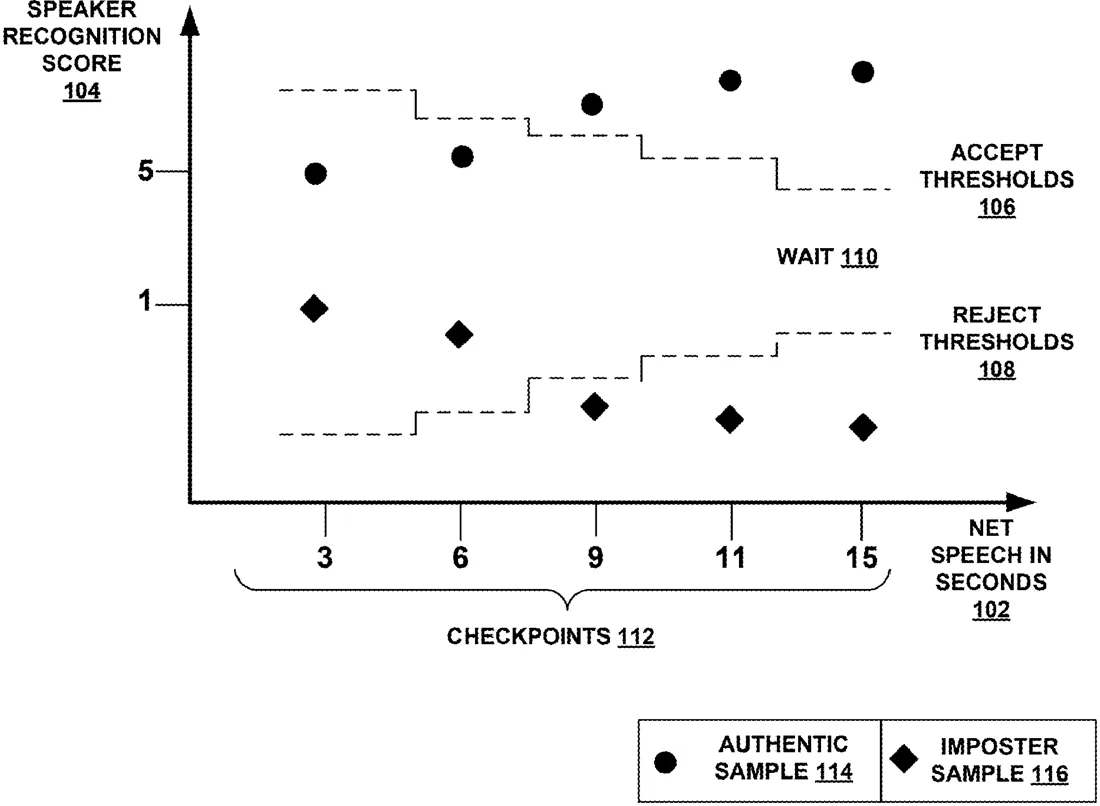
Microsoft describes a method for voice authentication systems to make accept or reject decisions sooner than waiting for a full recording. It uses reinforcement learning to find the best moment to stop analyzing a voice sample, balancing speed against the risk of letting an imposter in or locking out a real user.
In the filing’s own words
The decision thresholds for a speaker recognition system are pre-computed based on scores from trials consisting of imposter voice samples and authentic voice samples and are used in real-time for the system to make a decision to accept or reject a voice input at an earlier checkpoint with minimal accuracy loss. The speaker recognition system is represented as a Markov Decision Process (MDP) using scores from the trials generated at multiple checkpoints. A reinforcement learning solution is then used to determine the optimal policy for the MDP. The optimal policy is applied to the scores from the trials to extrapolate the decision thresholds for each checkpoint.
What exactly they claim (claim 1)
1. An automated system for generating decision thresholds for a speaker recognition system, comprising: a processor and a memory; wherein the memory stores a program that is configured to be executed by the processor, wherein the program comprises instructions to perform acts that: obtain a plurality of voice samples comprising imposter voice samples and authentic voice samples; generate a plurality of scores from the plurality of voice samples, wherein a score is generated for each checkpoint of a plurality of checkpoints based on a similarity with a pre-existing speaker profile; compute a false acceptance rate (FAR) value and a false rejection rate (FRR) value for each score at each checkpoint from the plurality of scores; generate, from the plurality of scores, a Markov Decision Process (MDP) to represent the speaker recognition system, wherein the MDP comprises a plurality of states, a plurality of actions, and a plurality of transition probabilities, a plurality of rewards, and a discount factor, wherein a state of the plurality of states comprises a select score of the plurality of scores at a select checkpoint of the plurality of checkpoints or a terminal state that terminates processing, wherein the plurality of rewards and the discount factor are set to values that promote a decision at an earlier checkpoint, wherein a transition probability represents a probability of transitioning to a terminal state of the plurality of states based on the FAR values and the FRR values generated from the plurality of scores; generate, through reinforcement learning, an optimal policy for each state of the MDP that achieves a maximum cumulative reward; and extrapolate the decision thresholds for each checkpoint of the plurality of checkpoints from application of the optimal policy to each score of the plurality of scores, wherein the decision thresholds comprise an accept threshold and a reject threshold for each checkpoint of the plurality of checkpoints.
Facts
- Company
- Microsoft (MICROSOFT TECHNOLOGY LICENSING, LLC.)
- Official title
- REAL-TIME STOPPING DECISIONS FOR VOICE AUTHENTICATION
- Publication number
- US20260301746A1
- Application number
- 19090256
- Filed
- Mar 25, 2025
- Published
- Oct 1, 2026
- Inventors
- 1
- Claims
- 20
Classified under
G10L 17/04 Physics & computingG06F 21/32 Physics & computingMore from Microsoft in Security & privacy
- Microsoft patents system to call 911 for others during video calls Sep 22, 2026
- Microsoft patents system to block fake code suggested by AI Sep 15, 2026
- Microsoft patents one-way data flow to block network attacks Sep 10, 2026
- Microsoft patents voice coding that hides speaker identity for secure calls Sep 17, 2026
- Microsoft patents security checks for AI chats using user and model profiles Oct 1, 2026
Summaries are simplified from the filing’s own abstract and first claim. A patent filing is not a product announcement.
Patent data and drawings: U.S. Patent and Trademark Office (USPTO). Nebula is not affiliated with or endorsed by the USPTO.