Google patents method to label who spoke in a transcript using sound direction
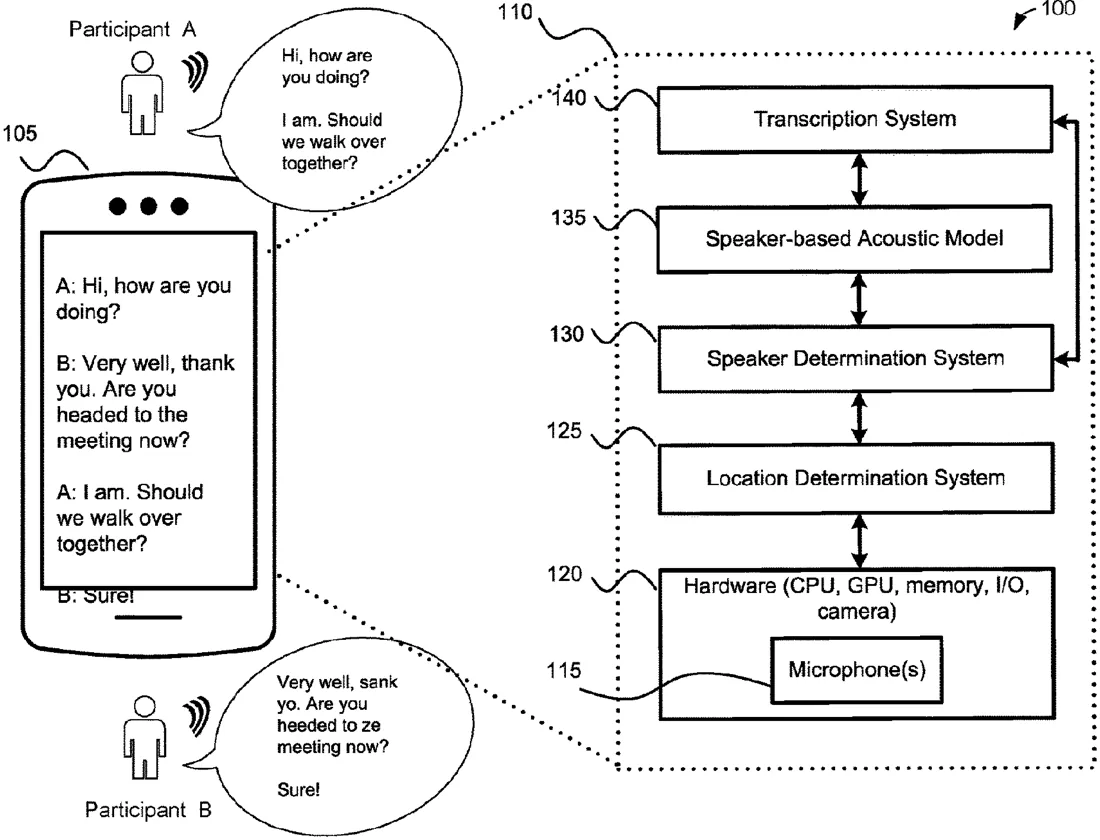
Google describes a system that uses two microphones to detect the slight time difference in when sound reaches each one. By calculating the direction of the sound, the system can match specific parts of a text transcript to the correct speaker in a conversation.
In the filing’s own words
An example method includes receiving first and second audio signals from respective first and second audio input devices. The first and second audio signals correspond to speech input of a conversation between two participants. The method includes estimating, based on the first and second audio signals, a time delay in respective arrival times for the speech input at the first and second audio input devices. The method includes estimating respective directions for two audio sources based on the estimated time delay in the respective arrival times. The method includes associating, based on the estimated directions of the two audio sources, respective portions of a speech-to-text transcript of the conversation with the respective participants. The method includes displaying based on the associating of the respective portions, a modified speech-to-text transcript of the conversation that labels the respective portions of the speech-to-text transcript associated with the respective participants.
What exactly they claim (claim 1)
1. A computer-implemented method, comprising: receiving, by a computing device, first and second audio signals from respective first and second audio input devices, wherein the first and second audio signals correspond to speech input of a conversation between two participants; estimating, by the computing device and based on the first and second audio signals, a time delay in respective arrival times for the speech input at the first and second audio input devices; estimating, by the computing device, respective directions for two audio sources based on the estimated time delay in the respective arrival times; associating, based on the estimated directions of the two audio sources, respective portions of a speech-to-text transcript of the conversation with the respective participants; and displaying, by the computing device and based on the associating of the respective portions, a modified speech-to-text transcript of the conversation that labels the respective portions of the speech-to-text transcript associated with the respective participants.
Facts
- Company
- Google (Google LLC)
- Official title
- Systems and Methods for Personalized Sound Localization in a Conversation
- Publication number
- US20260301745A1
- Application number
- 19478686
- Filed
- Apr 24, 2023
- Published
- Oct 1, 2026
- Inventors
- 11
- Claims
- 20
Classified under
G10L 17/02 Physics & computingG06F 40/103 Physics & computingG06F 40/166 Physics & computingG10L 25/06 Physics & computingMore from Google in Audio & voice
- Google patents voice assistant that cuts off its own answer to hear a new question Sep 15, 2026
- Google patents head-worn device that cleans up voice using bone vibration Sep 17, 2026
- Google patents voice assistant that asks before acting on commands Sep 1, 2026
- Google patents ring design to smooth out microphone sound quality Sep 1, 2026
- Google patents earbud part that combines sound and vibration Sep 8, 2026
Summaries are simplified from the filing’s own abstract and first claim. A patent filing is not a product announcement.
Patent data and drawings: U.S. Patent and Trademark Office (USPTO). Nebula is not affiliated with or endorsed by the USPTO.