Sony patents method to map surface roughness using polarized light
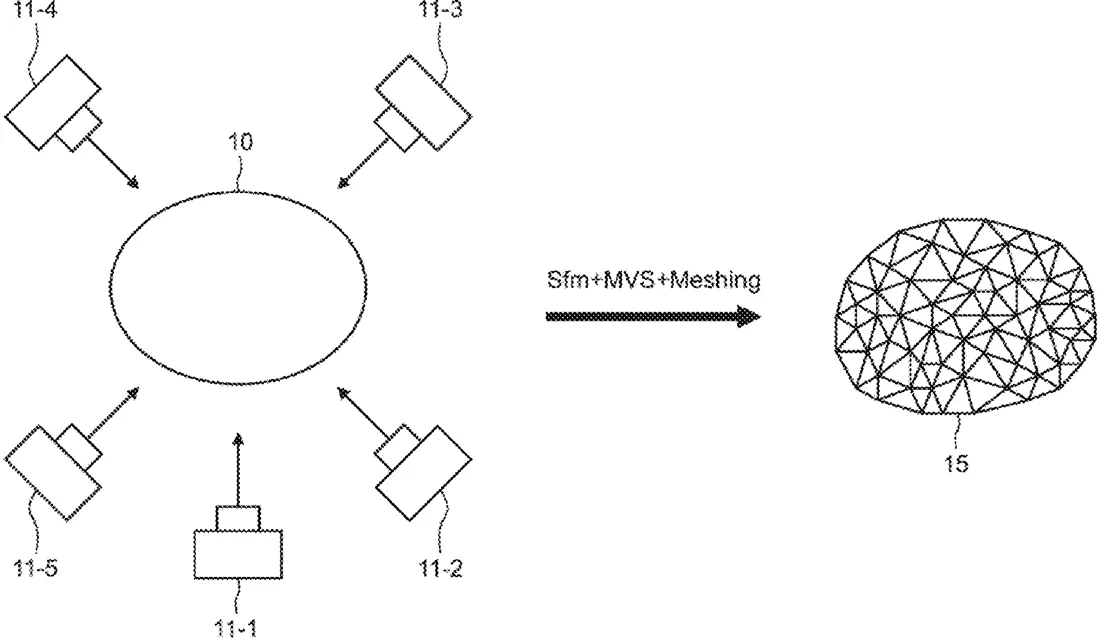
Sony describes a technique for estimating how rough a 3D object's surface is by analyzing two specific types of polarized light images. The system creates a 'roughness map' that shows how texture varies across the object, which helps maintain high-quality digital representations of physical items.
In the filing’s own words
The present disclosure relates to an information processing device and method to make it possible to suppress degradation of the quality of material information. Roughness estimation of estimating roughness of a surface of a 3D object is executed using a cross-polarization image and a parallel-polarization image, and a roughness map as distribution information of the roughness corresponding to the parallel-polarization image is generated. The cross-polarization image is a captured image generated by cross-polarization imaging. The parallel-polarization image is a captured image generated by parallel-polarization imaging. The present disclosure may be applied to, for example, an information processing device, an electronic device, an information processing method, a program or the like.
What exactly they claim (claim 1)
1. An information processing device comprising: a roughness map generation unit that executes roughness estimation of estimating roughness of a surface of a 3D object using a cross-polarization image and a parallel-polarization image, and generates a roughness map as distribution information of the roughness corresponding to the parallel-polarization image, wherein the cross-polarization image is a captured image generated by cross-polarization imaging, the parallel-polarization image is a captured image generated by parallel-polarization imaging, the captured image is generated by irradiating a subject with light from a light emitting unit and receiving light from the subject with an imaging unit, in a case of the cross-polarization image, light from the light emitting unit is polarized in a first polarization direction, and light from the subject is polarized in a second polarization direction perpendicular to the first polarization direction, and in a case of the parallel-polarization image, light from the light emitting unit is polarized in the first polarization direction, and light from the subject is polarized in the first polarization direction.
Facts
- Company
- Sony (SONY GROUP CORPORATION)
- Official title
- INFORMATION PROCESSING DEVICE AND METHOD
- Publication number
- US20260301302A1
- Application number
- 19479471
- Filed
- Apr 25, 2024
- Published
- Oct 1, 2026
- Inventors
- 3
- Claims
- 20
Classified under
G06T 15/04 Physics & computingMore from Sony in Cameras & imaging
- Sony patents camera chips that sign photos to prove they are real Sep 15, 2026
- Sony patents camera setup that learns to mimic a virtual view Sep 1, 2026
- Sony patents camera method to reduce lag in burst mode photos Sep 1, 2026
- Sony patents camera sensor design to improve global shutter image quality Sep 1, 2026
- Sony patents camera lens that subtracts light waves to cut data processing Sep 8, 2026
Summaries are simplified from the filing’s own abstract and first claim. A patent filing is not a product announcement.
Patent data and drawings: U.S. Patent and Trademark Office (USPTO). Nebula is not affiliated with or endorsed by the USPTO.