Google patents device lock that checks if it is in the right hands
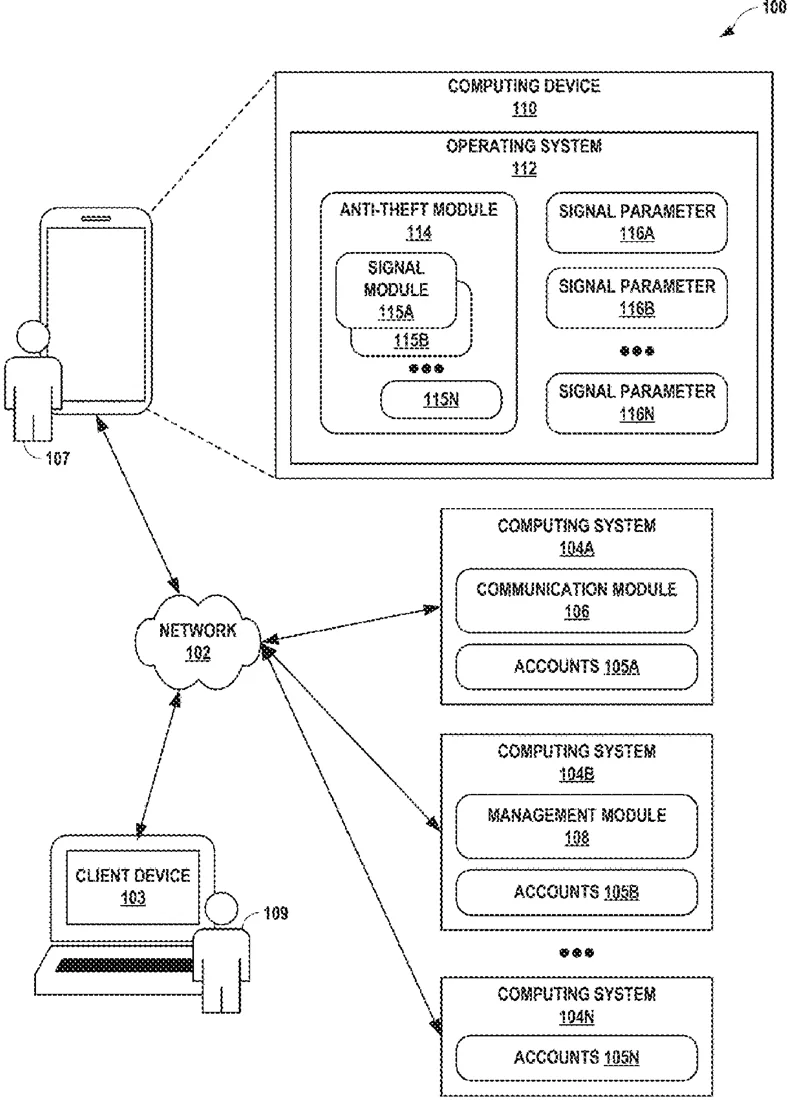
This filing describes a system where a device owner sets specific signal conditions, such as location or network details, before handing a computer to someone else. When the device wakes up, it compares its current signals to those saved parameters to decide if it is with the intended recipient. If the signals do not match, the device stays in a locked state with certain functions disabled.
In the filing’s own words
Device-based anti-theft and recovery techniques for computing devices are disclosed herein. An example system includes one or more processors that execute instructions to receive, from a transferor that intends to convey the computing device to a transferee, one or more signal parameters that, if satisfied, permit the computing device to deactivate a protected mode of operation; activate, during a normal mode of operation, the protected mode, wherein the computing device disables one or more functions that are enabled during the normal mode of operation while the protected mode is activated; receive, during the protected mode, a user input from a potential transferee corresponding to a wake function of the computing device; and responsive to receiving the user input, determine, based on a comparison between one or more signals associated with the computing device and the one or more signal parameters, whether the computing device is in possession of the transferee.
What exactly they claim (claim 1)
1. A method comprising: receiving, by a computing device and from a transferor that intends to convey the computing device to a transferee, one or more signal parameters that, if satisfied, permit the computing device to deactivate a protected mode of operation; activating, by the computing device and during a normal mode of operation, the protected mode, wherein the computing device disables one or more functions that are enabled during the normal mode of operation while the protected mode is activated; receiving, by the computing device and during the protected mode, a user input from a potential transferee, the user input corresponding to a wake function of the computing device; responsive to receiving the user input, determining, by the computing device and based on a comparison between one or more signals associated with the computing device and the one or more signal parameters, whether the computing device is in possession of the transferee; responsive to determining the computing device is in the possession of the transferee, deactivating, by the computing device, the protected mode of operation; and responsive to determining the computing device is not in the possession of the transferee, maintaining, by the computing device, the protected mode of operation.
Facts
- Company
- Google (Google LLC)
- Official title
- DEVICE-BASED ANTI-THEFT AND RECOVERY SYSTEM
- Publication number
- US20260300561A1
- Application number
- 19091165
- Filed
- Mar 26, 2025
- Published
- Oct 1, 2026
- Inventors
- 2
- Claims
- 20
Classified under
G06F 21/88 Physics & computingG06F 21/6218 Physics & computingMore from Google in Security & privacy
- Google patents privacy score for third-party apps Sep 22, 2026
- Google patents phone feature to disable unknown trackers Oct 8, 2026
- Google patents local face recognition for smart home cameras Sep 10, 2026
- Google patents system that finds and fills in email verification codes Sep 17, 2026
- Google patents AI agents that automatically investigate network security threats Oct 8, 2026
Summaries are simplified from the filing’s own abstract and first claim. A patent filing is not a product announcement.
Patent data and drawings: U.S. Patent and Trademark Office (USPTO). Nebula is not affiliated with or endorsed by the USPTO.