Amazon patents system to flag weird data sent to AI models
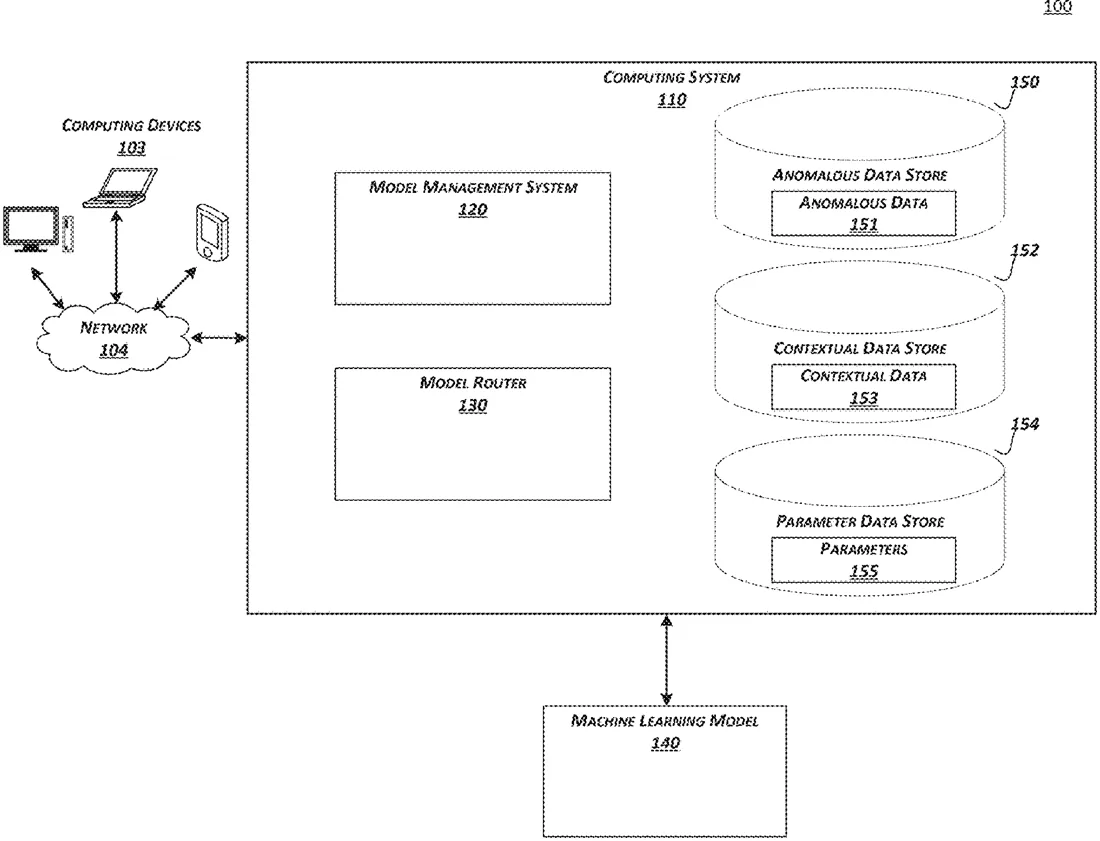
Amazon describes a method for checking data before and after it goes through a machine learning model. The system converts the data into a mathematical format called an embedding and compares it against a list of known 'weird' or anomalous data points. If the new data looks too similar to the bad examples, the system can drop it, filter it, or send it to a different destination instead of letting it pass through.
In the filing’s own words
Systems and methods are provided to detect anomalous data obtained from and/or to be routed to a machine learning model. A system can receive a first set of data associated with a machine learning model (e.g., an output of and/or an input to the machine learning model). The system can generate an embedding of the first set of data and can compare the embedding with a second set of data based on the first set of data being associated with the machine learning model. The system can determine a manner of processing the first set of data based on comparing the second set of data and the embedding and can process the first set of data according to the manner of processing the first set of data.
What exactly they claim (claim 1)
1. A computing system comprising: data processing hardware; and memory in communication with the data processing hardware, the memory storing instructions, wherein execution of the instructions by the data processing hardware causes the data processing hardware to: obtain, from a user computing device, a first input, wherein the first input comprises a request to generate an output using a machine learning model; obtain, from a data store, a set of data based on obtaining the first input, wherein the set of data comprises one or more vector embeddings of anomalous data associated with the machine learning model; generate, using an embedding model, a first vector embedding of the first input; compare, using a vector search, the first vector embedding and the one or more vector embeddings; determine a manner of processing the first input based on comparing the first vector embedding and the one or more vector embeddings, wherein the manner of processing the first input indicates to drop the first input, route the first input to a first destination, or filter the first input; route the first input to the machine learning model based on the manner of processing the first input; obtain a first output of the machine learning model based on routing the first input to the machine learning model; generate, using the embedding model, a second vector embedding of the first output; compare, using the vector search, the second vector embedding and the one or more vector embeddings; determine a manner of processing the first output based on comparing the first vector embedding and the one or more vector embeddings, wherein the manner of processing the first output indicates to drop the first output, route the first output to a second destination, or filter the first output; and process the first output according to the manner of processing the first output.
Facts
- Company
- Amazon (Amazon Technologies, Inc.)
- Official title
- EMBEDDING BASED ANOMALY DETECTION FOR MACHINE LEARNING MODELS
- Publication number
- US20260300066A1
- Application number
- 19096305
- Filed
- Mar 31, 2025
- Published
- Oct 1, 2026
- Inventors
- 4
- Claims
- 20
Classified under
G06F 11/0751 Physics & computingG06F 11/0721 Physics & computingMore from Amazon in AI & software
- Amazon patents system that cites sources for AI answers Sep 29, 2026
- Amazon patents tech to swap words in movies using actor's voice Sep 8, 2026
- Amazon patents ML tool to add graphics to live sports from moving cameras Sep 15, 2026
- Amazon patents shopping assistant that remembers your search filters Oct 6, 2026
- Amazon patents system where AI agents split tasks and talk to each other Oct 20, 2026
Summaries are simplified from the filing’s own abstract and first claim. A patent filing is not a product announcement.
Patent data and drawings: U.S. Patent and Trademark Office (USPTO). Nebula is not affiliated with or endorsed by the USPTO.