Amazon patents coding assistant that remembers your habits
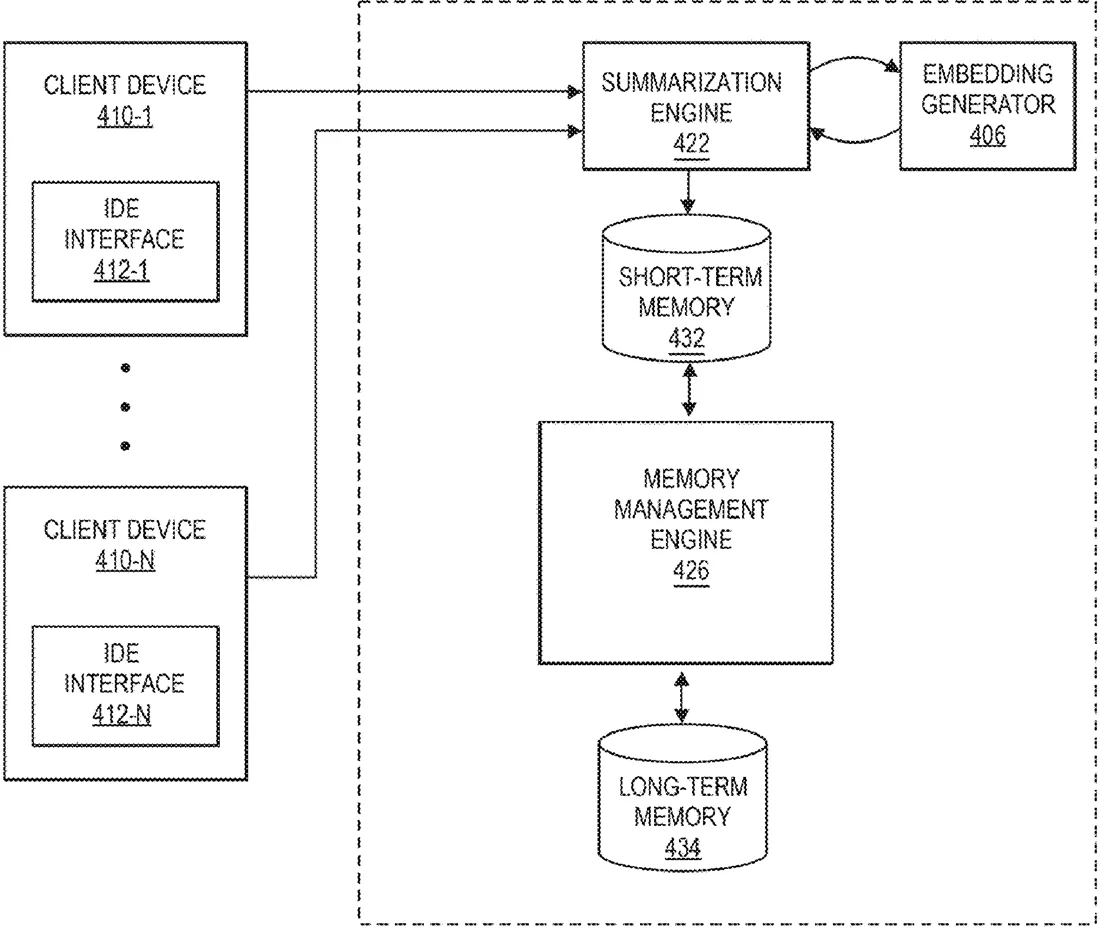
Amazon describes a system for coding tools that uses two types of memory to help developers. It keeps track of what you are doing right now in short-term memory and saves your long-term preferences in a separate section. The system learns from your actions to suggest code that fits your specific style.
In the filing’s own words
Disclosed are systems and methods for providing persistent, context-aware recommendations for IDE assistance tools. The disclosed systems and methods utilize a multi-layer memory architecture that includes a short-term memory and a long-term memory. The short-term memory stores representations of recent interactions and contextual information associated with a user for efficient retrieval, while the long-term memory stores patterns and preferences learned across multiple sessions (e.g., multiple sessions, multiple users, across an organization, etc.). The information stored in the short-term and long-term memories are managed and maintained based on various parameters, conflict resolution, implicit and explicit feedback signals, and the like. Recommendations are retrieved from the multi-layer memory using a weighted relevance function that is continuously optimized based on interactions with the user.
What exactly they claim (claim 1)
1. An agentic memory system, comprising: a first memory having a first portion and a second portion, the first portion storing a first set of short-term information and the second portion storing a second set of long-term information; a memory management system including one or more processors and a second memory storing program instructions that, when executed by the one or more processors, cause the one or more processors to at least: ingest a user interaction with an integrated development environment (IDE) and cause a representation of the user interaction to be stored in the first portion of the memory to be included in the first set of short-term information; manage at least one of the first set of short-term information or the second set of long-term information, wherein managing at least one of the first set of short-term information or the second set of long-term information includes at least one of: transferring, based at least in part on the first set of short-term information, at least a portion of the first set of short-term information from the first portion of the first memory to the second portion of the first memory to be included in the second set of long-term information; or deleting, based at least in part on the second set of long-term information, at least a portion of the second set of long-term information from the second portion of the first memory; and retrieve, in response to a triggering event, responsive information from at least one of the first portion of the first memory or the second portion of the first memory based at least in part on a relevance of the triggering event to at least one of the first set of short-term information or the second set of long-term information.
Facts
- Company
- Amazon (Amazon Technologies, Inc.)
- Official title
- AGENTIC MEMORY SYSTEM FOR EVOLVING CUSTOMIZED PROGRAM DEVELOPMENT PATTERNS
- Publication number
- US20260299893A1
- Application number
- 19092382
- Filed
- Mar 27, 2025
- Published
- Oct 1, 2026
- Inventors
- 5
- Claims
- 20
Classified under
G06F 8/33 Physics & computingG06F 40/30 Physics & computingMore from Amazon in AI & software
- Amazon patents system that cites sources for AI answers Sep 29, 2026
- Amazon patents tech to swap words in movies using actor's voice Sep 8, 2026
- Amazon patents ML tool to add graphics to live sports from moving cameras Sep 15, 2026
- Amazon patents shopping assistant that remembers your search filters Oct 6, 2026
- Amazon patents system where AI agents split tasks and talk to each other Oct 20, 2026
Summaries are simplified from the filing’s own abstract and first claim. A patent filing is not a product announcement.
Patent data and drawings: U.S. Patent and Trademark Office (USPTO). Nebula is not affiliated with or endorsed by the USPTO.