Google patents wearable method to predict future heart rhythm issues
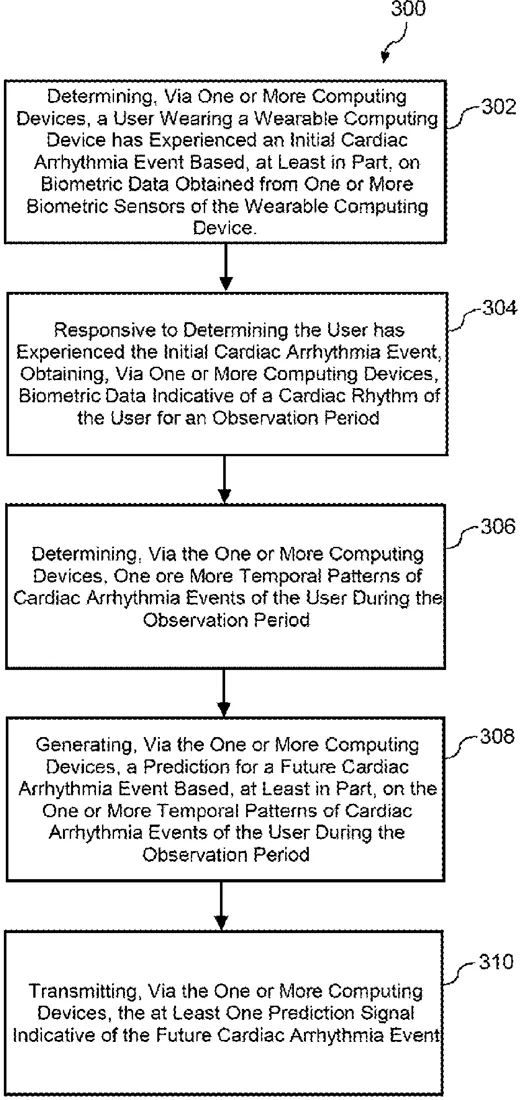
Google has filed a patent for a method that uses a wearable device to predict when a user might experience a specific heart rhythm problem called atrial fibrillation. The system first detects an initial heart event using built-in sensors, then monitors the user's heart rhythm over a set period to identify patterns that suggest when the next event might occur.
In the filing’s own words
A method for predicting a cardiac arrhythmia event is provided. The method includes determining a user wearing a wearable computing device has experienced an initial cardiac arrhythmia event based, at least in part, on biometric data obtained from one or more biometric sensors of the wearable computing device. The method includes obtaining biometric data indicative of a cardiac rhythm of the user for an observation period in response to determining the user has experienced the initial cardiac arrhythmia event. The method includes determining one or more temporal patterns of cardiac arrhythmia events of the user during the observation period. The method includes generating a prediction for at least one future cardiac arrhythmia event based, at least in part, on the one or more temporal patterns of cardiac arrhythmia events of the user during the observation period.
What exactly they claim (claim 1)
1. A method for predicting a cardiac arrhythmia event, the method comprising: determining, via one or more computing devices, a user wearing a wearable computing device has experienced an initial cardiac arrhythmia event based, at least in part, on biometric data obtained from one or more biometric sensors of the wearable computing device; responsive to determining the user has experienced the initial cardiac arrhythmia event, obtaining, via the one or more computing devices, biometric data indicative of a cardiac rhythm of the user for an observation period; determining, via the one or more computing devices, one or more temporal patterns of cardiac arrhythmia events of the user during the observation period; and generating, via the one or more computing devices, a prediction for at least one future cardiac arrhythmia event based, at least in part, on the one or more temporal patterns of cardiac arrhythmia events of the user during the observation period.
Facts
- Company
- Google (Google LLC)
- Official title
- Methods for Predicting Atrial Fibrillation (AFIB) Occurrences Using a Wearable Device
- Publication number
- US20260294263A1
- Application number
- 19477390
- Filed
- Apr 21, 2023
- Published
- Oct 1, 2026
- Inventors
- 2
- Claims
- 20
Classified under
A61B 5/02438 Human necessitiesA61B 5/02416 Human necessitiesA61B 5/681 Human necessitiesA61B 5/7264 Human necessitiesA61B 5/7275 Human necessitiesA61B 5/7282 Human necessitiesMore from Google in Health & body
- Google patents using phone cameras to measure heart and breathing rates Sep 15, 2026
- Google patents eye scan that spots diabetes from front-of-eye photos Sep 15, 2026
- Google patents system to spot surgical errors in video Sep 3, 2026
- Google patents phone sensor that measures blood pressure from a fingertip Sep 17, 2026
- Google patents radar and wearable tech for non-invasive blood pressure checks Sep 24, 2026
Summaries are simplified from the filing’s own abstract and first claim. A patent filing is not a product announcement.
Patent data and drawings: U.S. Patent and Trademark Office (USPTO). Nebula is not affiliated with or endorsed by the USPTO.