Amazon patents tool that uses AI to split large software into smaller parts
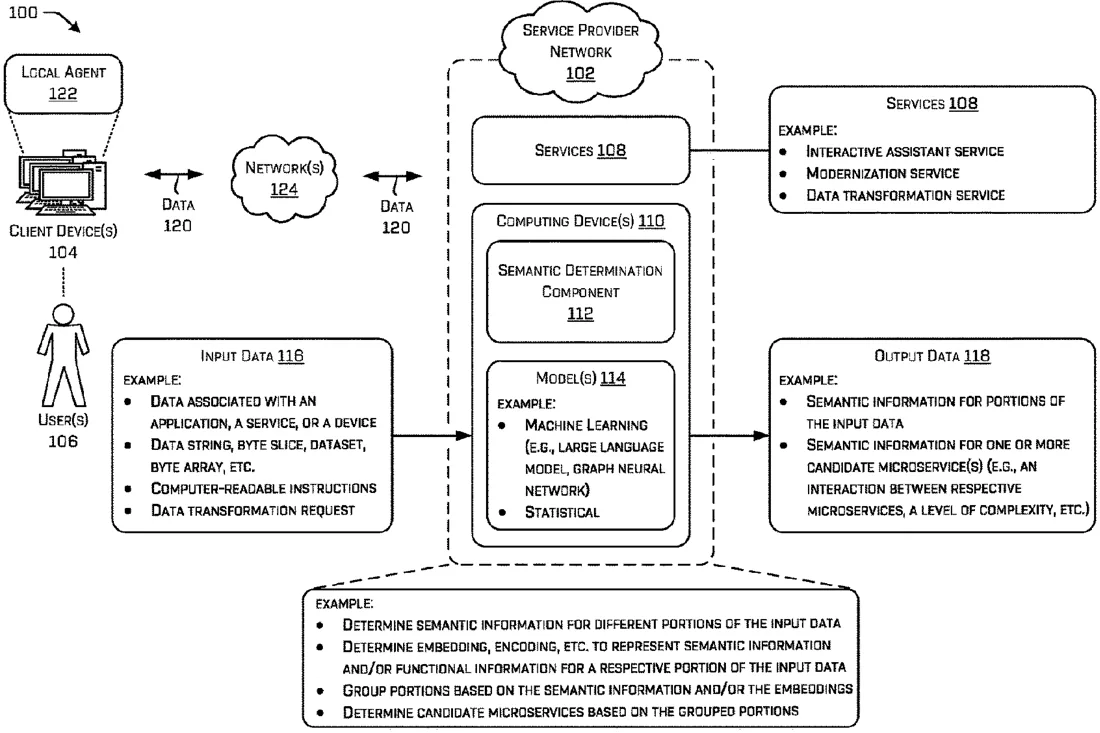
Amazon has patented a system that uses a large language model and other AI tools to analyze the code of a large, single-piece software application. The system groups similar code sections together and suggests how to break the application into smaller, independent services known as microservices.
In the filing’s own words
Techniques for automatically determining semantic information for portions of data using a large language model (LLM) and a machine learning model are discussed herein. For example, the LLM can receive initial input data representing a data string, byte slice, or computer-readable instructions, and output descriptions for different portions of the input data. The machine learning model can receive at least some of the descriptions output by the LLM, and determine one or more clusters of different portions. Each cluster can represent a business domain category, or microservice, for decomposing or otherwise modifying the initial input data. The techniques can include determining descriptions for each of the clusters to convey which microservices may be used in a microservice architecture. The techniques can include determining semantic meanings for microservices usable for application decomposition.
What exactly they claim (claim 1)
1. A system comprising: a large language model (LLM); a graph neural network (GNN); a clustering model; and a microservice extractor executing on a set of computing devices, the microservice extractor configured to perform operations comprising: receiving, from a computing device at a first time, a request to transform at least a portion of a monolithic application from a first data format to a second data format; inputting source code of the monolithic application into the LLM at a second time after the first time based at least in part on receiving the request at the first time; using the LLM to generate descriptions of respective segments of the source code of the monolithic application; using the GNN to generate, based at least partly on the descriptions of the respective segments of the source code, node embeddings representing both semantic and topological information of the respective segments; using the clustering model to identify, from the node embeddings, a set of clusters of the respective segments of the source code; using the LLM to generate natural language descriptions of respective clusters in the set of clusters; and causing output, to a user of a software application, of a decomposition proposal recommending a set of microservices that the monolithic application can be decomposed into, the set of microservices corresponding to the set of clusters, wherein the decomposition proposal includes the natural language descriptions of the respective clusters.
Facts
- Company
- Amazon (Amazon Technologies, Inc.)
- Official title
- Microservice semantic determination by a model
- Patent number
- US12769950B1
- Application number
- 18622586
- Filed
- Mar 29, 2024
- Granted
- Oct 20, 2026
- Inventors
- 2
- Claims
- 20
Classified under
G06F 40/30 Physics & computingMore from Amazon in AI & software
- Amazon patents system that cites sources for AI answers Sep 29, 2026
- Amazon patents tech to swap words in movies using actor's voice Sep 8, 2026
- Amazon patents ML tool to add graphics to live sports from moving cameras Sep 15, 2026
- Amazon patents shopping assistant that remembers your search filters Oct 6, 2026
- Amazon patents system where AI agents split tasks and talk to each other Oct 20, 2026
Summaries are simplified from the filing’s own abstract and first claim. A patent filing is not a product announcement.
Patent data and drawings: U.S. Patent and Trademark Office (USPTO). Nebula is not affiliated with or endorsed by the USPTO.