Apple patents camera parts that move without tangling wires
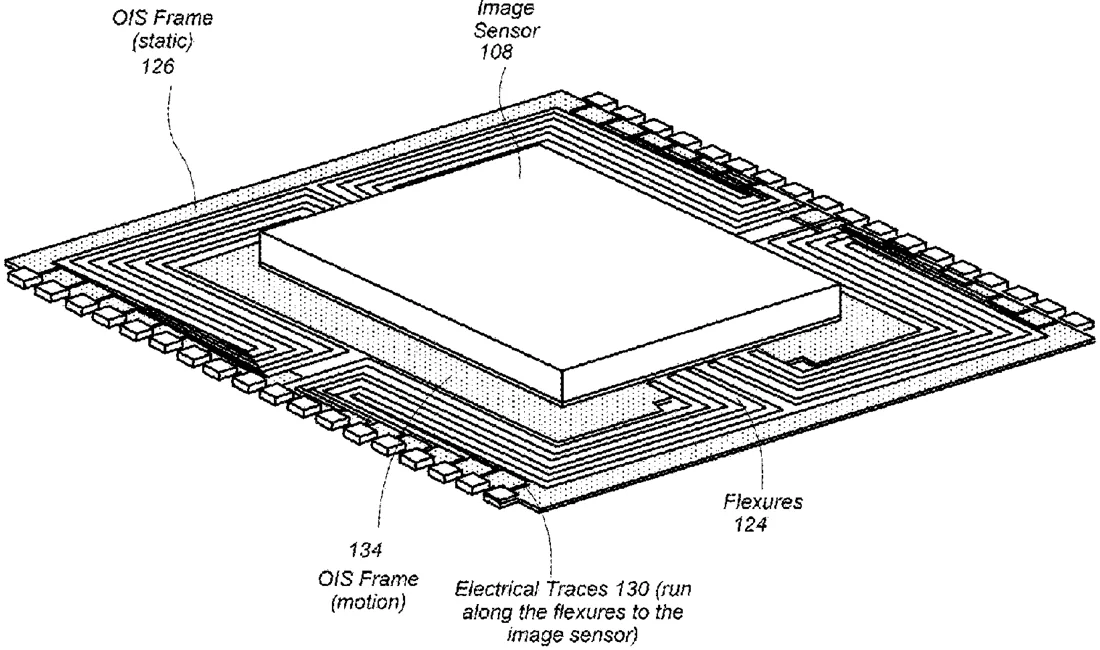
Apple describes a camera design where separate flexible arms carry electrical signals between the moving sensor and the fixed body. These arms work alongside a suspension system that stabilizes the image, keeping the electrical connections distinct from the mechanical parts that allow movement.
In the filing’s own words
Flexure component(s), including arms physically separate from suspension flexures, in a sensor-shift camera, route power to and/or high-speed data produced by an image sensor, reducing complexity of the suspension. A camera includes a static portion (e.g., a base or non-moving portion of a platform of the camera) attached to one side of flexure component(s). The moving portion (e.g., a moving platform that supports an image sensor, or the lenses) is attached to the other side of the flexure component(s). The one or more flexible electrical flexure component(s) may route power, image data signals, and/or control signals between the static and a moving portion of the camera. In embodiments, a suspension (e.g., a flexure-based suspension, physically distinct from the flexible electrical flexure component(s)) acts to moveably connect the static portion and the moveable portion while an actuator moves the moveable platform (e.g., for image stabilization or autofocus).
What exactly they claim (claim 1)
1. An actuator module for an image sensor, comprising: a moveable platform attached to an image sensor configured to receive light refracted by one or more lenses and to produce image data signals; a static portion; a suspension attached to the static portion and the moveable platform and configured to support movement of the moveable platform for image stabilization or for autofocus; an actuator configured to actuate the movement of the moveable platform for image stabilization or for autofocus; and one or more flexure components, individually comprising: a first bar attached to the moveable platform and a second bar attached to the static portion; and a plurality of pattern-shaped flexible arms connecting the first and second bars of the flexure component, wherein the pattern-shaped flexible arms are configured to move together in response to movement of the moveable platform relative to the static portion such that the pattern-shaped flexible arms move together in a deterministic manner to avoid contact between the pattern-shaped flexible arms during movement of the moveable platform; wherein the first bar and the second bar serve as respective common mounting portions for attaching each of the plurality of pattern-shaped flexible arms of the flexure component to the moveable platform and the static portion; and wherein at least one of the plurality of pattern-shaped flexible arms of the one or more flexure components is configured to route the image data signals, produced by the image sensor, from the moveable platform to the static portion.
Facts
- Company
- Apple (Apple Inc.)
- Official title
- Electrical flexure component, separate from suspension, for sensor shift cameras
- Patent number
- US12769180B2
- Application number
- 18770526
- Filed
- Jul 11, 2024
- Granted
- Oct 20, 2026
- Inventors
- 3
- Claims
- 20
Classified under
G03B 5/00 Physics & computingG03B 13/36 Physics & computingH02K 41/0356 Electricity & electronicsG03B 2205/0069 Physics & computingH02K 2201/18 Electricity & electronicsMore from Apple in Cameras & imaging
- Apple patents camera sensor with mixed-resolution zones for zoom lenses Sep 8, 2026
- Apple patents system to sync multiple video recordings into one timeline Sep 15, 2026
- Apple patents method to sync camera settings when one lens is blocked Sep 15, 2026
- Apple patents camera interface that blends zoom levels from multiple lenses Sep 15, 2026
- Apple patents wider video view using extra side cameras Sep 22, 2026
Summaries are simplified from the filing’s own abstract and first claim. A patent filing is not a product announcement.
Patent data and drawings: U.S. Patent and Trademark Office (USPTO). Nebula is not affiliated with or endorsed by the USPTO.