Google patents low-latency peer-to-peer network for live media
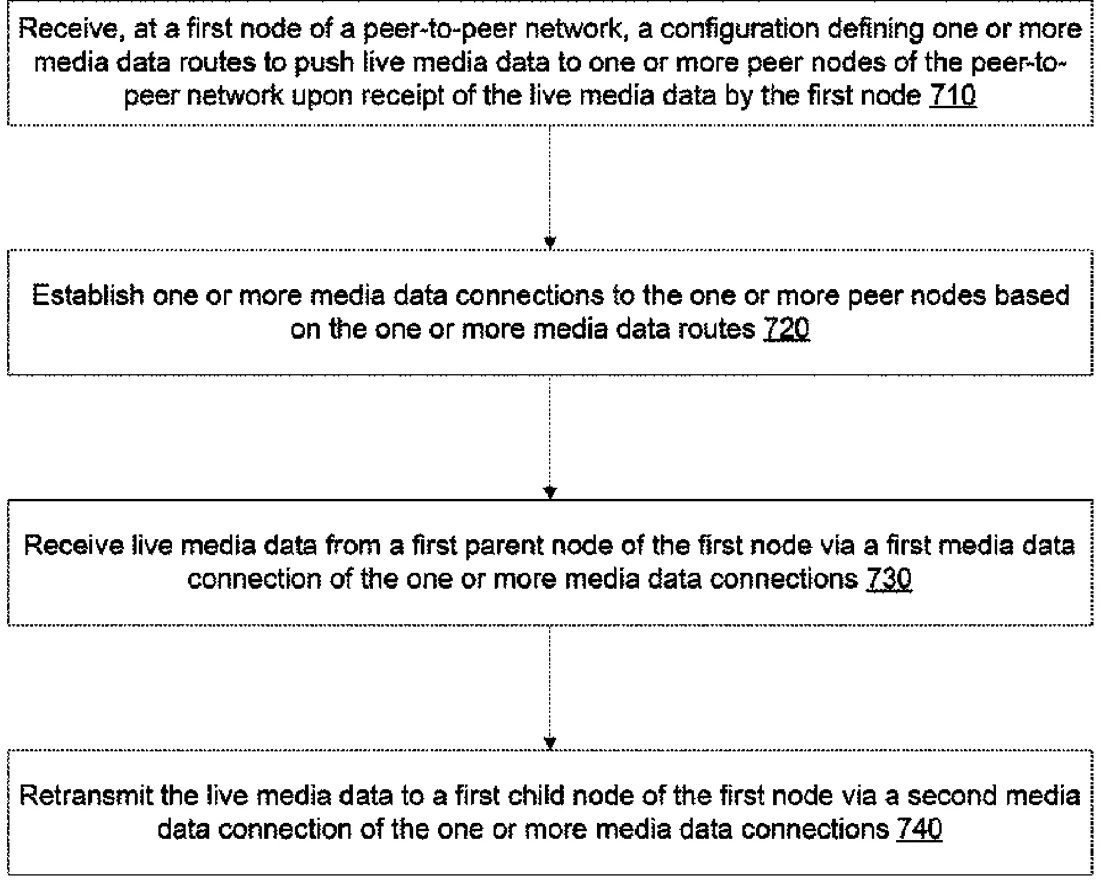
Google describes a method where a server organizes devices into a peer-to-peer network to share live media data. The server creates a specific configuration that maps out routes for the data to travel between devices, designating some as parents and others as children. This setup allows devices to forward live media to each other immediately upon receipt, reducing the need for a central server to handle all traffic.
In the filing’s own words
A method includes receiving, at a server, first requests to register with a first peer-to-peer network from a first node, a second node, and a third node, the first peer-to-peer network providing transmission of live media data. The method further includes generating a first configuration for the first peer-to-peer network comprising at least the first node, the second node, and the third node, the first configuration defining a first set of one or more media data routes to provide the live media data to one or more peer nodes of the first peer-to-peer network upon receipt of the live media data by a respective one of the first node, the second node, and the third node. The method further includes transmitting one or more portions of the first configuration to each of the first node, the second node, and the third node.
What exactly they claim (claim 1)
1. A method comprising: receiving, at a server, first requests to register with a first peer-to-peer network from a first node, a second node, and a third node, the first peer-to-peer network providing transmission of live media data; generating, at the server, a first configuration for the first peer-to-peer network comprising at least the first node, the second node, and the third node, wherein: the first configuration defines a first set of media data routes among the first node, the second node, and the third node prior to receipt of the live media data; the first configuration causes the first node, the second node, and the third node to forward the live media data based on the first set of media data routes upon receipt of the live media data by a respective one of the first node, the second node, or the third node; and the first configuration designates one or more of the first node, the second node, and the third node as child nodes of one or more other nodes to receive the live media data from a respective parent node of the one or more other nodes; and transmitting one or more portions of the first configuration to each of the first node, the second node, and the third node to cause the first node, the second node, and the third node to transfer the live media data according to the first set of media data routes.
Facts
- Company
- Google (Google LLC)
- Official title
- Low latency peer-to-peer network
- Patent number
- US12764183B2
- Application number
- 18588448
- Filed
- Feb 27, 2024
- Granted
- Oct 13, 2026
- Inventors
- 3
- Claims
- 20
Classified under
H04L 67/104 Electricity & electronicsH04L 67/63 Electricity & electronicsH04N 21/2187 Electricity & electronicsMore from Google in Networks & wireless
- Google patents way for phones to send data without waking up fully Sep 8, 2026
- Google patents faster data handoff for phones in standby mode Sep 15, 2026
- Google patents video calls that change quality settings mid-conversation Sep 29, 2026
- Google patents video coding that trims extra detail to fit bandwidth limits Sep 29, 2026
- Google patents method for phones to sync with satellite signals Sep 29, 2026
Summaries are simplified from the filing’s own abstract and first claim. A patent filing is not a product announcement.
Patent data and drawings: U.S. Patent and Trademark Office (USPTO). Nebula is not affiliated with or endorsed by the USPTO.