Google patents 3D data compression for AR and VR rendering
Google has been granted a patent for a method that compresses large 3D datasets, such as point clouds, into smaller files. The system uses a neural network to reconstruct specific 3D points from this compressed data, allowing for efficient storage and transmission. The filing specifically notes that this technology can be used to render augmented reality or virtual reality images.
In the filing’s own words
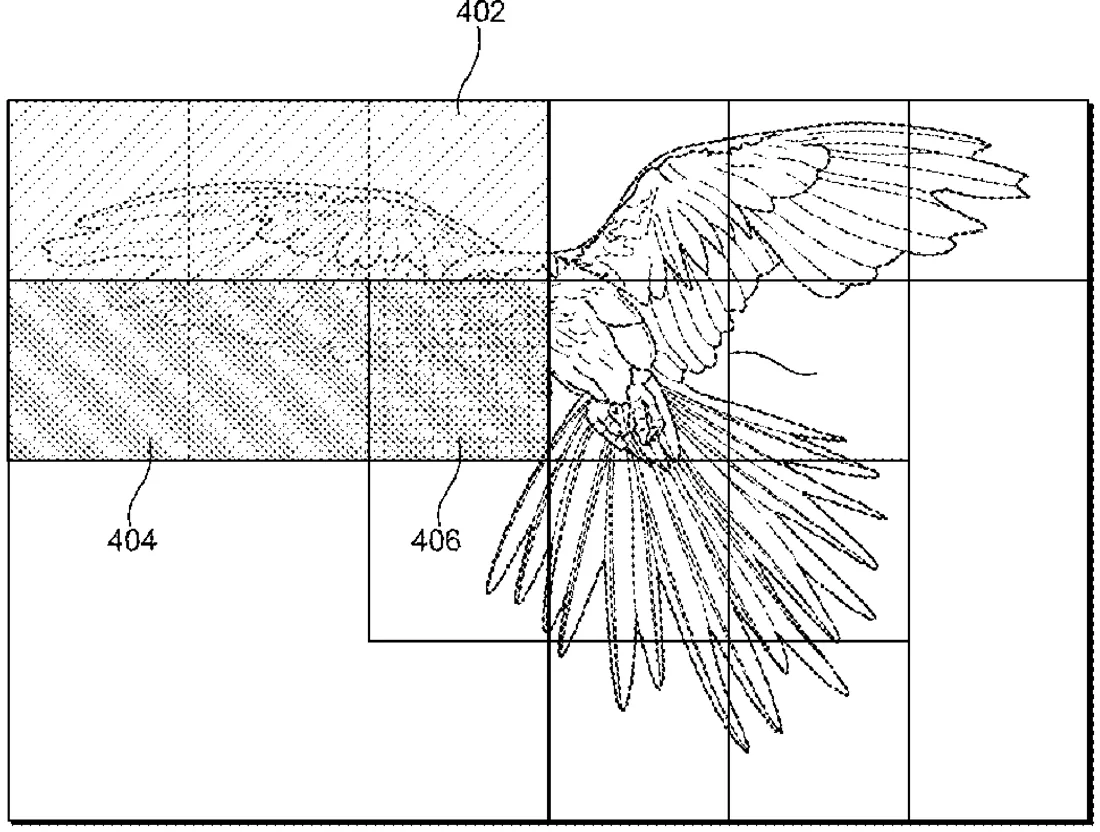
Example embodiments of the present disclosure relate to systems and methods for compressing attributes of volumetric and hypervolumetric datasets. An example system performs operations including obtaining a reference dataset comprising attributes indexed by a domain of multidimensional coordinates; subdividing the domain into a plurality of blocks respectively associated with a plurality of attribute subsets; inputting, to a local nonlinear operator, a latent representation for an attribute subset associated with at least one block of the plurality of blocks; obtaining, using the local nonlinear operator and based on the latent representation, an attribute representation of one or more attributes of the attribute subset; and updating the latent representation based on a comparison of the attribute representation and the reference dataset.
What exactly they claim (claim 1)
1. A computing system, comprising: one or more processors; and one or more non-transitory computer-readable media storing instructions that are executable by the one or more processors to cause the computing device to perform operations, the operations comprising: receiving a compressed encoding of attributes of a point cloud, wherein the compressed encoding comprises a plurality of component latent representations corresponding to blocks respectively containing sets of voxels of the point cloud; obtaining, for an input voxel, an input latent representation based on the plurality of component latent representations; generating, using a coordinate-based network and based on the input latent representation, an attribute representation corresponding to the input voxel, wherein the coordinate-based network receives, as an input, a coordinate of interest, and returns, as an output, an attribute value associated with the coordinate of interest, the coordinate-based network comprising parameters learned for a particular reference dataset describing three-dimensional imagery or parameters generalized across multiple reference datasets; and rendering an augmented reality image or a virtual reality image using the generated attribute representation.
Facts
- Company
- Google (Google LLC)
- Official title
- Learned volumetric attribute compression using coordinate-based networks
- Patent number
- US12762785B2
- Application number
- 18398009
- Filed
- Dec 27, 2023
- Granted
- Oct 13, 2026
- Inventors
- 5
- Claims
- 20
Classified under
G06T 15/08 Physics & computingH04N 19/176 Electricity & electronicsH04N 19/46 Electricity & electronicsMore from Google in AR, VR & displays
- Google patents video conference stage with built-in teleprompter Sep 15, 2026
- Google patents VR headset that checks your eyesight Oct 20, 2026
- Google patents glasses that share one lens for cameras and projectors Oct 20, 2026
- Google patents AR glasses with two separate screens in one lens Oct 1, 2026
- Google patents AR glasses that switch light paths to widen the view Oct 8, 2026
Summaries are simplified from the filing’s own abstract and first claim. A patent filing is not a product announcement.
Patent data and drawings: U.S. Patent and Trademark Office (USPTO). Nebula is not affiliated with or endorsed by the USPTO.