Google patents system to block search results for hidden bad terms
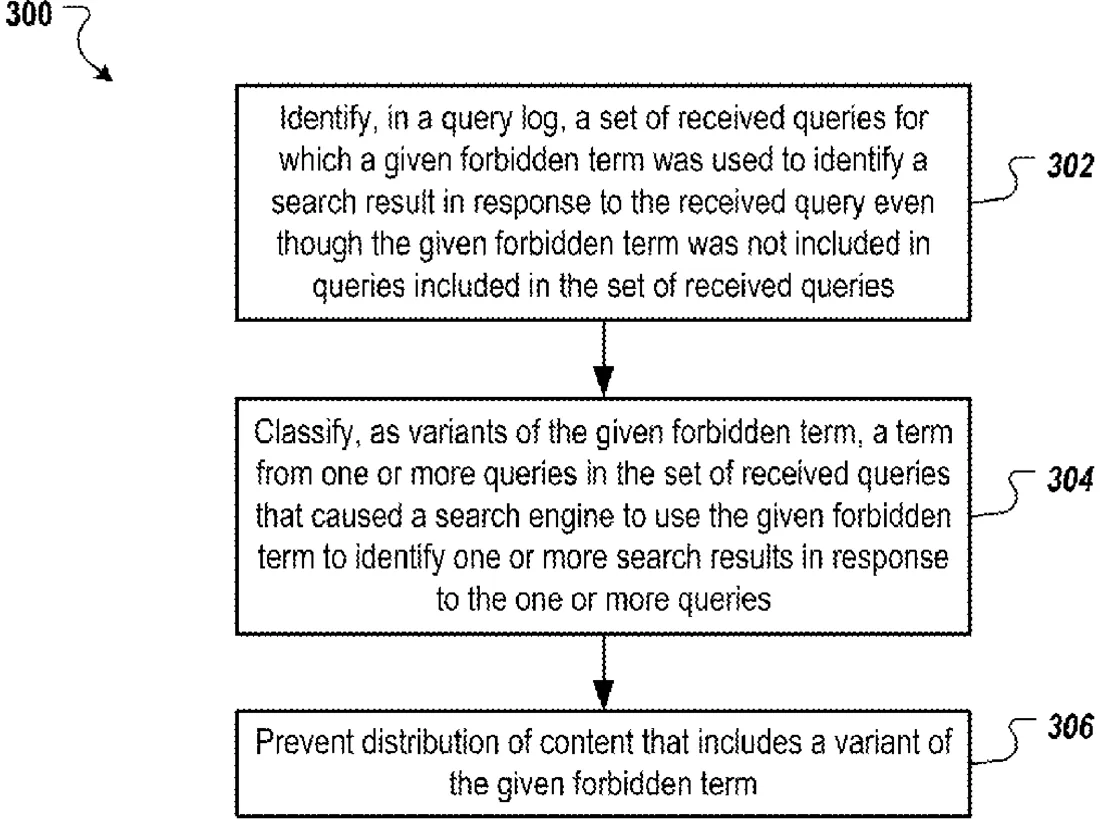
This patent describes a method for identifying and blocking specific words or phrases that lead users to forbidden content. The system analyzes search logs to find terms that cause a search engine to automatically replace or add a banned word, then adds those terms to a blocklist.
In the filing’s own words
The subject matter of this specification generally relates to preventing the distribution of forbidden network content. In one aspect, a system includes a front-end server that receives content for distribution over a data communication network. The back-end server identifies, in the query log, a set of received queries for which a given forbidden term was used to identify a search result in response to the received query even though the given forbidden term was not included in queries included in the set of received queries. The back-end server classifies, as variants of the given forbidden term, a term from one or more queries in the set of received queries that caused a search engine to use the given forbidden term to identify one or more search results in response to the one or more queries and prevents distribution of content that includes a variant.
What exactly they claim (claim 1)
1. A system comprising: one or more processors; and one or more storage devices storing instructions that, when executed by the one or more processors, cause the one or more processors to perform operations comprising: receiving content for distribution over a data communication network; updating a list of forbidden variants of forbidden terms for use in blocking distribution of content that presents any of the forbidden variants, the updating comprising: accessing a data source that includes a set of received queries that were received from client devices and for which results were returned to the client devices; identifying, in the data source, a subset of the received queries that were each adjusted to include a forbidden term in place of, or in addition to, one or more words of the received query prior to using the received query to identify a result in response to the received query; identifying, in the subset of received queries, candidate variants of the forbidden term, wherein each candidate variant is a word or phrase that (i) is included in at least one received query of the subset of received queries and (ii) caused a search engine to adjust the at least one received query to include the forbidden term; determining a score for each candidate variant based on a number of the received queries in the subset of received queries for which the candidate variant caused the search engine to adjust the received query to include the forbidden term in the received query; selecting, from the candidate variants, a set of forbidden variants of the forbidden term based at least on the score for each candidate variant; and adding the set of forbidden variants to the list of forbidden variants; and preventing distribution of content that depicts any forbidden variant in the list of forbidden variants.
Facts
- Company
- Google (Google LLC)
- Official title
- Preventing the distribution of forbidden network content using automatic variant detection
- Patent number
- US12762193B2
- Application number
- 18071306
- Filed
- Nov 29, 2022
- Granted
- Oct 13, 2026
- Inventors
- 4
- Claims
- 20
Classified under
G06F 16/9535 Physics & computingG06F 16/328 Physics & computingG06F 16/3349 Physics & computingG06F 16/355 Physics & computingG06F 16/374 Physics & computingG06F 16/9035 Physics & computingMore from Google in Security & privacy
- Google patents privacy score for third-party apps Sep 22, 2026
- Google patents phone feature to disable unknown trackers Oct 8, 2026
- Google patents local face recognition for smart home cameras Sep 10, 2026
- Google patents system that finds and fills in email verification codes Sep 17, 2026
- Google patents AI agents that automatically investigate network security threats Oct 8, 2026
Summaries are simplified from the filing’s own abstract and first claim. A patent filing is not a product announcement.
Patent data and drawings: U.S. Patent and Trademark Office (USPTO). Nebula is not affiliated with or endorsed by the USPTO.