Amazon patents TV radar that adjusts power to detect when you walk in
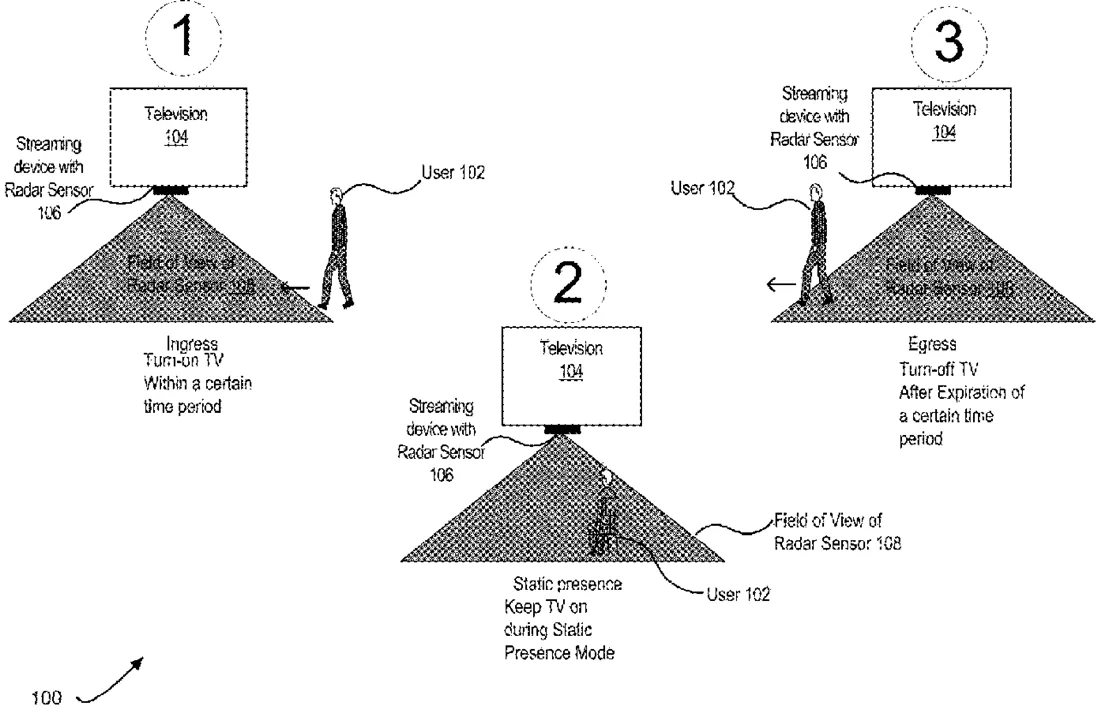
This patent describes a method for televisions to use radar sensors to detect when a person enters a room. The system switches between two modes: a high-speed setting to catch movement when you walk in, and a lower-power setting to confirm you are still there without using as much energy.
In the filing’s own words
Techniques for a dynamic radar mode modulation feature are described herein. A computer system associated with a device may implement a first radar configuration for a radar sensor. The first radar configuration may correspond to a first mode and comprise a first frame per second rate and a first difference threshold. The computer system may receive first data from the radar sensor in the first radar configuration. The computer system may determine a presence of an object within a field of view of the radar sensor based on the first data and the first difference threshold. The computer system may instruct the device to turn on based on determining the presence of the user. The radar sensor may be instructed to implement a second radar configuration associated with a second mode.
What exactly they claim (claim 1)
1. A computer-implemented method, comprising: implementing, by a television, a first radar configuration for a radar sensor communicatively coupled with the television, the first radar configuration associated with an ingress mode and comprising a first frame per second (FPS) rate and a first difference threshold, wherein the first difference threshold is based at least in part on an average magnitude of radar signal returns detected by the radar sensor over a period of time and a multiplier; receiving, by the television, first data comprising at least two consecutive frames, wherein the at least two consecutives frames comprise output data of radar signal returns from the radar sensor that is using the first radar configuration; determining, by the television, a presence of a user within a field of view of the radar sensor based at least in part on whether a difference between a peak magnitude of radar signal returns in a first frame of the first data and a peak magnitude of radar signal returns in a second frame of the first data exceeds the first difference threshold; instructing, by the television, the television to turn on based at least in part on determining the presence of the user; receiving, by the television, second data from the radar sensor that is using the first radar configuration; determining, by the television, an absence of the user within the field of view of the radar sensor based at least in part on the second data and the first difference threshold; implementing, by the television, a second radar configuration associated with a static presence mode in response to determining the absence of the user, the second radar configuration comprising a second FPS rate and a second difference threshold; receiving, by the television, third data from the radar sensor that is using the second radar configuration; determining, by the television, a static presence of the user within the field of view of the radar sensor based at least in part on the third data and the second difference threshold; and instructing, by the television, to maintain an on state for the television based at least in part on determining the static presence of the user.
Facts
- Company
- Amazon (Amazon Technologies, Inc.)
- Official title
- Presence detection with dynamic radar operating modes
- Patent number
- US12761722B2
- Application number
- 18066703
- Filed
- Dec 15, 2022
- Granted
- Oct 13, 2026
- Inventors
- 8
- Claims
- 20
Classified under
G06F 3/011 Physics & computingG01S 13/04 Physics & computingH04N 7/0255 Electricity & electronicsMore from Amazon in Phones & computers
- Amazon patents e-reader screen design for even lighting Sep 1, 2026
- Amazon patents remote control for mobile devices via push notifications Sep 29, 2026
Summaries are simplified from the filing’s own abstract and first claim. A patent filing is not a product announcement.
Patent data and drawings: U.S. Patent and Trademark Office (USPTO). Nebula is not affiliated with or endorsed by the USPTO.