Google patents stacked waveguide design to reduce eye movement issues
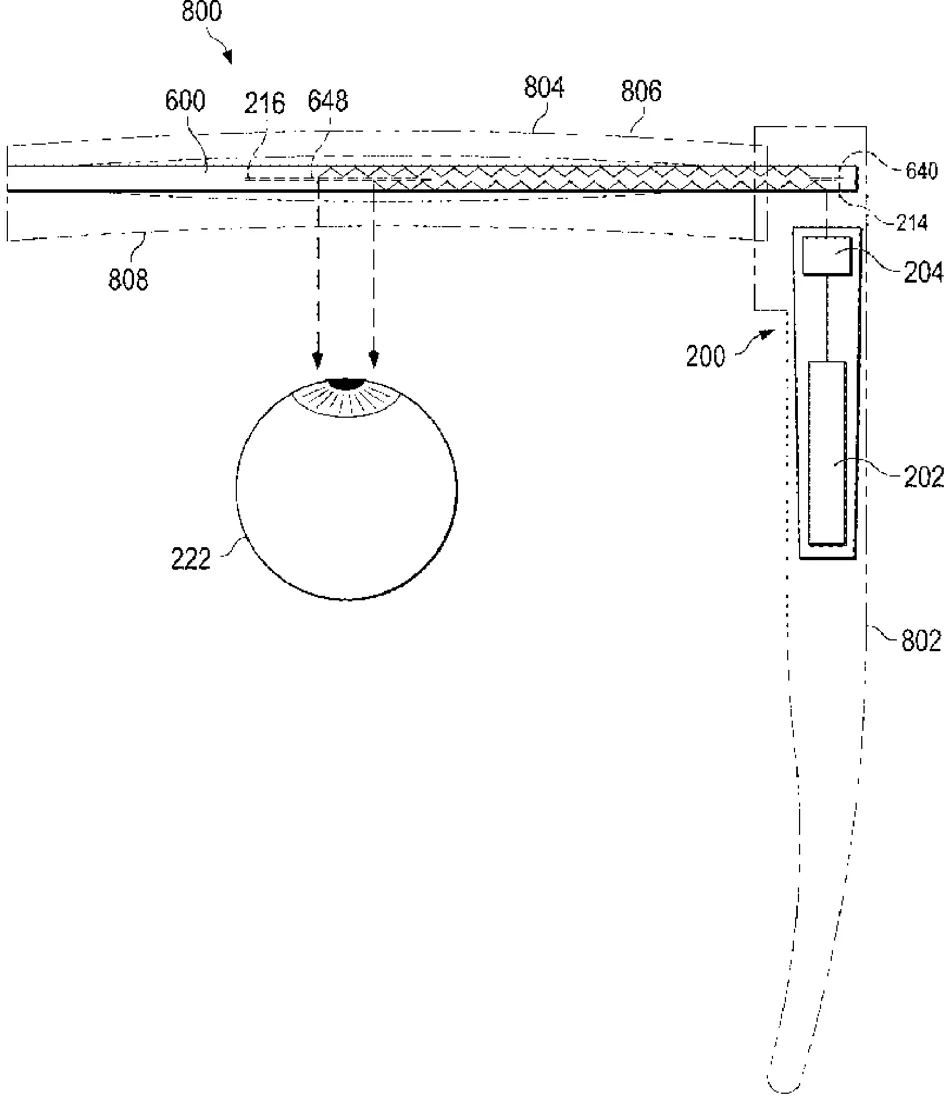
Google has been granted a patent for a stacked waveguide design used in head-mounted displays. The invention arranges two layers of glass with different light-coupling patterns to guide images to the user's eyes. This specific layout aims to make the display less sensitive to the user's pupil moving around.
In the filing’s own words
A first waveguide of a stacked waveguide located closest to the eye of a user operates in a reflection mode such that the set of grating structures of the first waveguide are disposed on a surface of the first waveguide opposite the eye of the user and towards the interior of the stacked waveguide. Additionally, a second waveguide of the stacked waveguide located further from the eye of the user operates in a transmission mode such that the grating structures of the second waveguide are disposed on a surface of the second waveguide facing the eye of the user and facing the interior of the stacked waveguide.
What exactly they claim (claim 1)
1. A stacked waveguide, comprising: a first waveguide including a first set of grating structures disposed on a first surface of the first waveguide facing an interior of the stacked waveguide, the first set of grating structures forming a first incoupler configured to direct a first portion of received light into a body of the first waveguide so as to be guided by total internal reflection inside the body of the first waveguide; a first surface of the stacked waveguide formed from a second surface of the first waveguide opposite the first surface of the first waveguide; a second waveguide including a second set of grating structures disposed on a first surface of the second waveguide facing the interior of the stacked waveguide and the first surface of the first waveguide, the second set of grating structures forming a second incoupler configured to direct a second portion of received light into a body of the second waveguide so as to be guided by total internal reflection inside the body of the second waveguide; and a second surface of the stacked waveguide formed from a second surface of the second waveguide opposite the first surface of the second waveguide, the second surface of the stacked waveguide opposite the first surface of the stacked waveguide.
Facts
- Company
- Google (GOOGLE LLC)
- Official title
- High-reliability stacked waveguide with reduced sensitivity to pupil walk
- Patent number
- US12761477B2
- Application number
- 18137397
- Filed
- Apr 20, 2023
- Granted
- Oct 13, 2026
- Inventors
- 2
- Claims
- 20
Classified under
G02B 27/0172 Physics & computingG02B 27/0081 Physics & computingG02B 2027/0178 Physics & computingMore from Google in AR, VR & displays
- Google patents video conference stage with built-in teleprompter Sep 15, 2026
- Google patents VR headset that checks your eyesight Oct 20, 2026
- Google patents glasses that share one lens for cameras and projectors Oct 20, 2026
- Google patents AR glasses with two separate screens in one lens Oct 1, 2026
- Google patents AR glasses that switch light paths to widen the view Oct 8, 2026
Summaries are simplified from the filing’s own abstract and first claim. A patent filing is not a product announcement.
Patent data and drawings: U.S. Patent and Trademark Office (USPTO). Nebula is not affiliated with or endorsed by the USPTO.