Apple patents system that combines heart rate data from multiple wearables
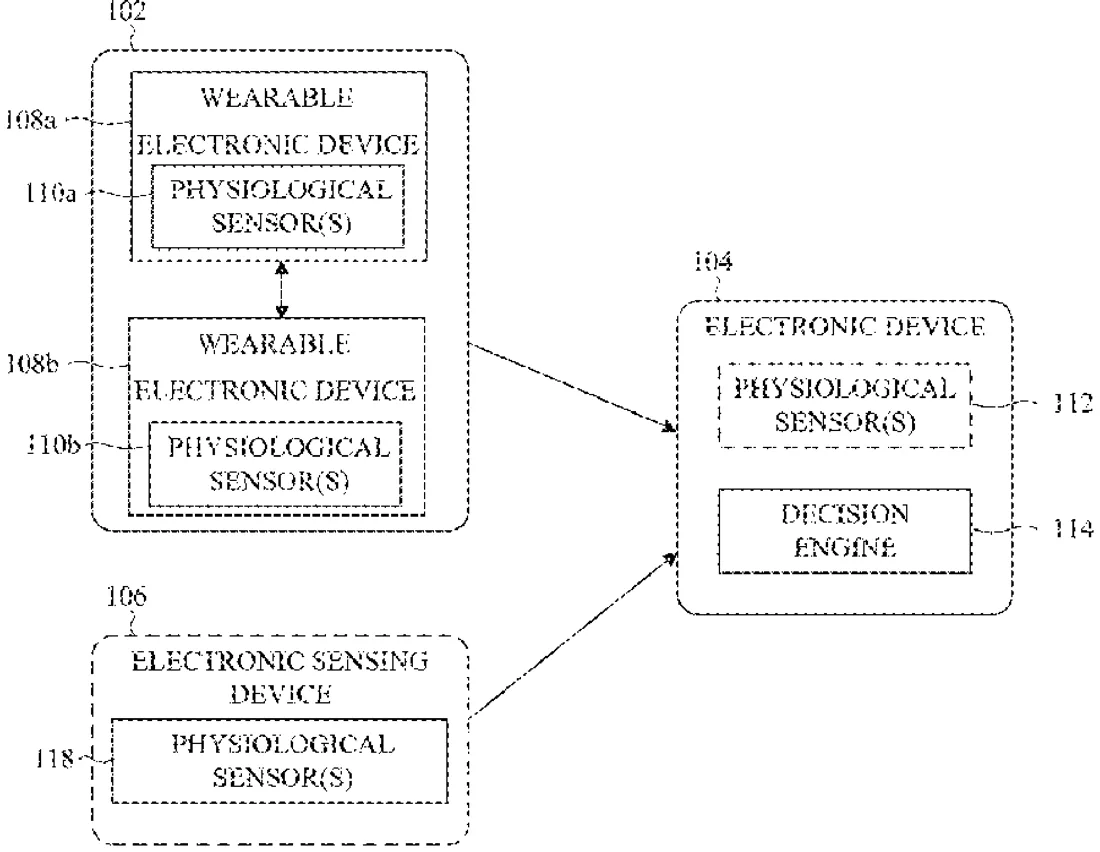
Apple has been granted a patent for a system that measures a user's heart rate by combining data from multiple wearable devices. The system allows one device to receive heart rate readings from others, compare them, and send the most relevant data to a third device to calculate a final, more accurate heart rate value.
In the filing’s own words
Embodiments include systems and methods for determining a physiological value of a user. The systems and methods described herein may be configured to select and obtain physiological metrics from multiple electronic devices in order to generate an output physiological value for a measured physiological parameter. In some cases, an electronic device is configured to receive physiological metrics from one or more other electronic devices and generate the output physiological value using one or more of the received physiological metrics. Additionally, in some cases, the electronic device may be configured to generate a physiological metric (e.g., using a physiological sensor incorporated in the electronic device), and may use both the generated physiological metric and the one or more received physiological metrics in generating the output physiological value.
What exactly they claim (claim 1)
1. A system for determining a heart rate of a user, the system comprising: a first wearable electronic device comprising a first heart rate sensor and a first wireless communication device, the first wearable electronic device configured to operate the first heart rate sensor to detect a first heart rate metric at a first location on the user; a second wearable electronic device comprising a second heart rate sensor and a second wireless communication device, the second wearable electronic device configured to: operate the second heart rate sensor to detect a second heart rate metric at a second location on the user; and operate the second wireless communication device to transmit the second heart rate metric to the first wearable electronic device; a third wearable electronic device comprising a third heart rate sensor and a third wireless communication device, the third wearable electronic device configured to operate the third heart rate sensor to detect a third heart rate metric at a third location on the user, wherein: the first wearable electronic device is configured to: compare the first heart rate metric to the second heart rate metric for a first measurement window; and operate the first wireless communication device to transmit, for the first measurement window, one of the first heart rate metric or the second heart rate metric to the third wearable electronic device based on the comparison; and the third wearable electronic device is configured to: use the received one of the first heart rate metric or the second heart rate metric, and the third heart rate metric, to generate a heart rate value for the user for the first measurement window; and cause the generated heart rate value to be output to the user.
Facts
- Company
- Apple (Apple Inc.)
- Official title
- Dynamic multi-device physiological measurement systems and methods
- Patent number
- US12758110B2
- Application number
- 19267320
- Filed
- Jul 11, 2025
- Granted
- Oct 13, 2026
- Inventors
- 2
- Claims
- 20
Classified under
A61B 5/0255 Human necessitiesA61B 5/0205 Human necessitiesA61B 5/02416 Human necessitiesA61B 5/02438 Human necessitiesA61B 5/11 Human necessitiesA61B 5/7271 Human necessitiesMore from Apple in Wearables
- Apple patents smart glasses that show notifications when you aren't looking at your phone Sep 1, 2026
- Apple patents fabric earbuds woven to fit your ear shape Sep 1, 2026
- Apple patents wristband that reads tendon movement to detect gestures Oct 13, 2026
- Apple patents wearable that adjusts video based on your comfort Oct 15, 2026
- Apple patents stylus that tracks hand tremors and grip strength Sep 22, 2026
Summaries are simplified from the filing’s own abstract and first claim. A patent filing is not a product announcement.
Patent data and drawings: U.S. Patent and Trademark Office (USPTO). Nebula is not affiliated with or endorsed by the USPTO.