SpaceX patents method to equalize signal delays across satellite beams
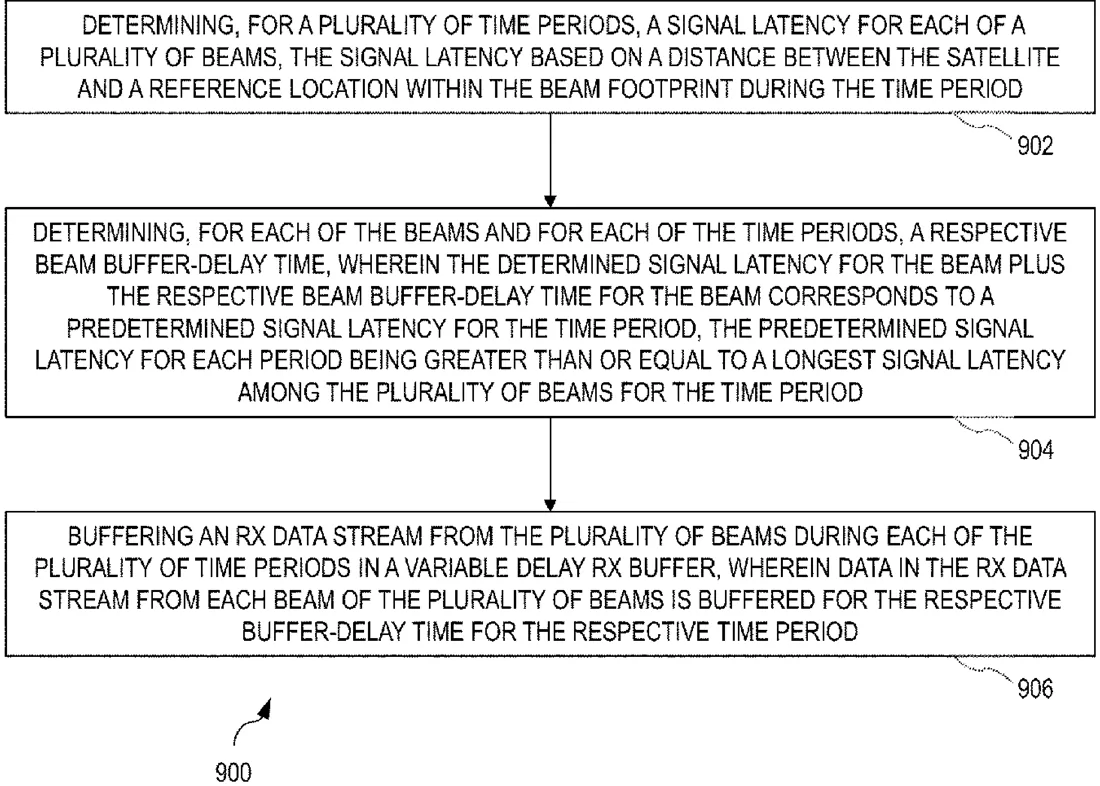
SpaceX describes a system for satellites that use directional beams to communicate with phones on the ground. The satellite calculates how long it takes for signals to travel from different parts of its coverage area and holds the faster signals in a digital buffer. This ensures all data arrives at the same time, preventing the signal from becoming out of sync.
In the filing’s own words
A satellite computer system for a satellite can include at least one processor programmed to perform one or more steps. The satellite includes a phased array antenna configured to communicate with terrestrial user equipment (UE) via a plurality of directional beams. The steps can include: determining a signal latency for each of the beams based on a distance between the satellite and a reference location within the beam footprint during a time period; determining, for each of the beams, a respective beam buffer-delay time, wherein the determined signal latency for the beam plus the respective beam buffer-delay time corresponds to a predetermined signal latency for the time period; and buffering an Rx data stream from the beams in a variable delay Rx buffer, wherein data in the Rx data stream from each beam of the plurality of beams is buffered for the respective buffer-delay time for the respective time period.
What exactly they claim (claim 1)
1. A satellite computer system for a satellite, the satellite including a phased array antenna configured to send and receive signals to terrestrial user equipment (UE) on a radio access network (RAN) via a plurality of directional beams, each of the beams having a beam footprint that defines a cell of the RAN, the satellite computer system comprising at least one processor in communication with a memory, the memory storing computer-readable instructions that are executable to cause the at least one processor to perform steps including: determining, for each time period of a plurality of time periods, a signal latency for each of the plurality of directional beams, the signal latency based on a distance between the satellite and a reference location within the beam footprint during the respective time period; determining, for each directional beam of the plurality of directional beams for each time period of the plurality of time periods, a respective beam buffer-delay time, wherein the determined signal latency for the respective directional beam plus the respective beam buffer-delay time for the respective directional beam corresponds to a predetermined signal latency for the respective time period, the predetermined signal latency for the respective time period being greater than or equal to a longest signal latency among the plurality of directional beams for the respective time period; and buffering an Rx data stream from the plurality of directional beams during each time period of the plurality of time periods in a variable delay Rx buffer, wherein data in the Rx data stream from each directional beam of the plurality of directional beams is buffered for the respective beam buffer-delay time for the respective time period.
Facts
- Company
- SpaceX (Space Exploration Technologies Corp.)
- Official title
- Systems and methods for latency equalization in a satellite cellular telecommunications network
- Patent number
- US12757141B1
- Application number
- 18425414
- Filed
- Jan 29, 2024
- Granted
- Oct 6, 2026
- Inventors
- 4
- Claims
- 20
Classified under
H04W 56/0045 Electricity & electronicsH04B 7/18513 Electricity & electronicsH04B 7/2125 Electricity & electronicsMore from SpaceX in Networks & wireless
- SpaceX patents router that switches between wide and focused Wi-Fi beams Sep 15, 2026
- SpaceX patents method to self-calibrate large antenna arrays in flight Sep 17, 2026
Summaries are simplified from the filing’s own abstract and first claim. A patent filing is not a product announcement.
Patent data and drawings: U.S. Patent and Trademark Office (USPTO). Nebula is not affiliated with or endorsed by the USPTO.