Samsung patents wearable that tracks brain waves to suggest health actions
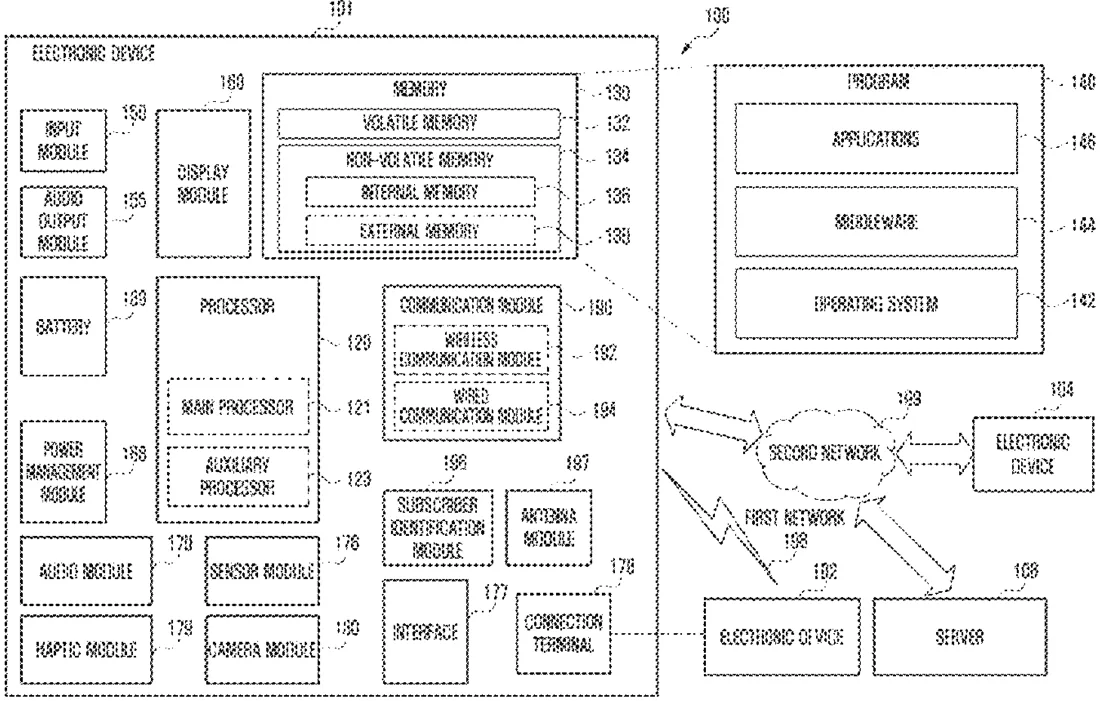
Samsung has been granted a patent for a wearable device that measures biometric data like heart rate, stress, and brain activity at regular intervals. The device compares this data with personal thresholds and location information to classify the user's mental state and display specific advice, such as exercises to improve blood flow or oxygen levels.
In the filing’s own words
An electronic device comprising: a sensor; a memory; and a first processor, wherein the first processor is configured to: receive first data of a user of the electronic device sensed at preconfigured intervals via the sensor; identify second data comprising location information of the user or information input by the user; compare the first data and the second data with threshold values pre-stored in the memory to generate a result; detect a current health state of the user based on the result; output recommended guide information based on the detected current health state; and re-detect the current health state of the user based on changed first data received at the preconfigured intervals and the second data.
What exactly they claim (claim 1)
1. A wearable electronic device comprising: a sensor configured to sense biometric information of a user at preconfigured intervals; memory configured to store threshold values and executable instructions; a display; and a first processor operably coupled to the sensor, memory, and display, the first processor comprising software modules configured to execute a set of instructions stored in the memory to: control the sensor to automatically measure the biometric information of the user at the preconfigured intervals; obtain, from the sensor, the biometric information of the user measured by the sensor at the preconfigured intervals, the biometric information including heart rate, an electrocardiogram, stress level, and a number of steps; quantify the biometric information of the user measured by the sensor into first data, the first data being at least one of electroencephalography (EEG) information including sensorimotor rhythm, regional cerebral blood flow, levels of neurotransmitter, heart rate, stress level, blood pressure, blood oxygen concentration, or a blood carbon dioxide concentration; identify, via processor, second data comprising at least one of a location information of the user or user-inputted information; compare the first data and the second data with threshold values pre-stored in the memory to generate a result, using a predefined learning algorithms and signal processing techniques, the threshold values being values indicating normal ranges of biometric information statistically based on user information; detect a current health state of the user based on the result, the current health state of the user being a mental state classification label of the user; control the display to output recommended guide information according to the detected current health state to the user, the recommended guide information including at least one of guide information for physical activity to enable alteration of EEG, alteration of blood flow to a first normal range, or alteration of blood oxygen concentration to a second normal range; re-detect the current health state of the user based on changed first data obtained by quantifying changed biometric information measured at the preconfigured intervals and the second data, the changed first data being at least one of EEG information including sensorimotor rhythm, regional cerebral blood flow, levels of neurotransmitter, heart rate, stress level, blood pressure, blood oxygen concentration, or blood carbon dioxide concentration, and the current health state of the user being the mental state classification label of the user; transmit the first data and the second data to an external device using a communication module, to enable the external device to generate updated recommended guide information, based on the first data, the second data, and a plurality of other pieces of data for other users having similar characteristics to the user of the wearable electronic device received from a plurality of other electronic devices associated with the other users; receive the updated recommended guide information from the external device, the updated recommended guide information including at least one of guide information for physical activity to enable alteration of EEG, alteration of blood flow to the first normal range, or alteration of blood oxygen concentration to the second normal range; and control the display to output guide information included in the updated recommended guide information received from the external device, that is determined to be applicable to the current health state of the user based on the changed first data, and the second data, wherein the updated recommended guide information comprises recommendations to the user based on aggregated habit-related data of the other users of the plurality of other electronic devices.
Facts
- Company
- Samsung (SAMSUNG ELECTRONICS CO., LTD.)
- Official title
- Electronic device and health management method using same
- Patent number
- US12755823B2
- Application number
- 18106228
- Filed
- Feb 6, 2023
- Granted
- Oct 6, 2026
- Inventors
- 4
- Claims
- 12
Classified under
G16H 20/00 Physics & computingG16H 10/60 Physics & computingG16H 40/67 Physics & computingG16H 50/30 Physics & computingMore from Samsung in Wearables
- Samsung patents wristwatch with flexible screen that wraps around your wrist Oct 15, 2026
- Samsung patents ring that projects a screen onto your skin Oct 22, 2026
- Samsung patents glasses with moving lenses to adjust focus Sep 1, 2026
- Samsung patents wearable that adjusts walking force while you test walk Sep 8, 2026
- Samsung patents virtual trainer that overlays your video on an avatar Sep 8, 2026
Summaries are simplified from the filing’s own abstract and first claim. A patent filing is not a product announcement.
Patent data and drawings: U.S. Patent and Trademark Office (USPTO). Nebula is not affiliated with or endorsed by the USPTO.