Apple patents display fix for uneven brightness in fine patterns
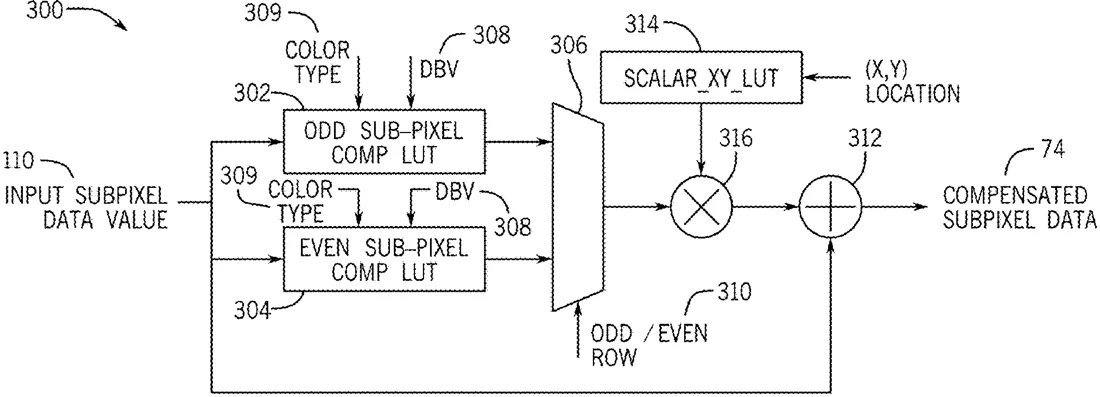
Apple describes a method to correct a visual glitch where fine, high-contrast patterns cause some screen rows to appear brighter than others. The system uses specific lookup tables to adjust the data sent to odd and even rows, balancing the voltage fluctuations that cause this mismatch.
In the filing’s own words
Display pixels of an electronic display may exhibit front-of-screen distortions when high spatial frequency image data is applied on the electronic display panel. The high spatial frequency may generate voltage ripple on a storage capacitor of pixel driving circuitry, causing mismatch between luminance of a first subpixel on an odd-numbered row and a corresponding subpixel on an even-numbered row. This odd-even row mismatch may be compensated via mismatch compensation circuitry. The mismatch compensation circuitry may include an odd subpixel compensation LUT and an even subpixel compensation LUT. The odd subpixel compensation LUT may output odd subpixel compensation values and the even subpixel compensation LUT may output even subpixel compensation values. The multiplexer may combine the odd subpixel compensation values and the even subpixel compensation values with input image data to generate compensated subpixel data, which may reduce or eliminate the odd-even row mismatch.
What exactly they claim (claim 1)
1. An electronic device, comprising: an electronic display; and processing circuitry configured to: receive image data comprising first subpixel data corresponding to a display subpixel of a first row and second subpixel data corresponding to a display subpixel of a second row; apply a first subpixel compensation value to the first subpixel data to generate first compensated subpixel data configured to compensate for a data voltage mismatch between the first row and the second row due to fluctuations of a scan signal when the image data is to be sampled in the first row as compared to the second row; apply a second subpixel compensation value to the second subpixel data to generate second compensated subpixel data configured to compensate for the data voltage mismatch between the first row and the second row due to the fluctuations of the scan signal when the image data is to be sampled in the second row as compared to the first row; apply a third subpixel compensation value to the first compensated subpixel data in a first clock cycle to generate first adjusted subpixel data and apply a fourth subpixel compensation value to the second compensated subpixel data in a second clock cycle, wherein the third subpixel compensation value is based on a location of the display subpixel of the first row with respect to a voltage source of the electronic display, and wherein the fourth subpixel compensation value is based on a location of the display subpixel of the second row with respect to the voltage source; and output the first adjusted subpixel data and the second adjusted subpixel data to the electronic display.
Facts
- Company
- Apple (Apple Inc.)
- Official title
- Systems and methods for compensating for scan signal induced odd-even row mismatch
- Patent number
- US12755667B2
- Application number
- 19044279
- Filed
- Feb 3, 2025
- Granted
- Oct 6, 2026
- Inventors
- 6
- Claims
- 20
Classified under
G09G 3/2074 Physics & computingG09G 3/3233 Physics & computingG09G 2300/0804 Physics & computingG09G 2300/0819 Physics & computingG09G 2300/0842 Physics & computingG09G 2310/0205 Physics & computingMore from Apple in AR, VR & displays
- Apple patents AR glasses that zoom in on what you look at Sep 8, 2026
- Apple patents finger ring that controls VR with taps and waves Sep 15, 2026
- Apple patents head-mounted device that types via eye swipes and hand pinches Oct 6, 2026
- Apple patents eye-tracking and hand gestures to select screen items Oct 20, 2026
- Apple patents AR glasses that adjust lenses to fit your eyes Sep 17, 2026
Summaries are simplified from the filing’s own abstract and first claim. A patent filing is not a product announcement.
Patent data and drawings: U.S. Patent and Trademark Office (USPTO). Nebula is not affiliated with or endorsed by the USPTO.