Google patents ad system that picks content in secure, private steps
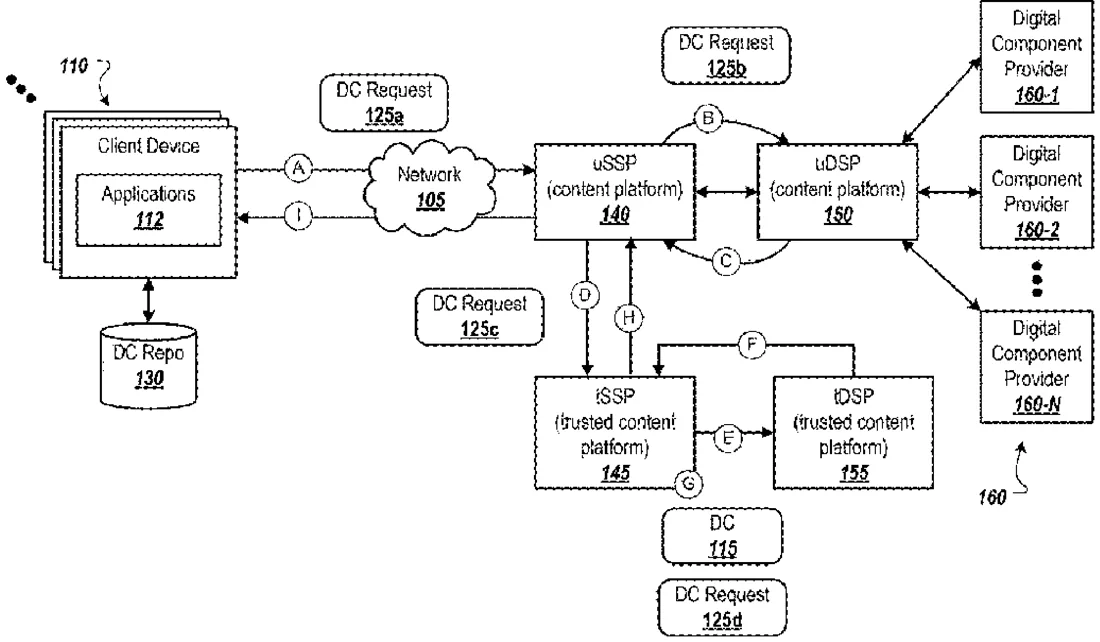
Google describes a method for selecting digital content, such as ads, by splitting the process between two isolated, secure software environments. The first environment handles general context while the second applies specific distribution rules, allowing the system to choose a final item without exposing sensitive details to either side. The selected content is then sent to a standard, non-secure platform for delivery to the user's device.
In the filing’s own words
Methods, systems, and apparatus, including medium-encoded computer program products for selecting and displaying content in privacy preserving manners are described. A first trusted content platform (CP) that executes within a first trusted environment can receive a digital component (DC) response that can include: (i) data indicating constrained DCs and, for each constrained DC, distribution parameters; and (ii) data indicating at least one contextual DC selected according to contextual data. The first trusted CP can send to a second trusted CP a second DC request that can include set of constraining values and the distribution parameters. The first trusted CP can receive from the second trusted CP, data indicating (i) one or more constrained DCs selected and (ii) selection values generated based on the set of constraining values. The first trusted CP can select a DC based on a selection value for each contextual DC and the selection value.
What exactly they claim (claim 1)
1. A computer-implemented method comprising: receiving, by a first trusted content platform that executes within a first trusted execution environment, a digital component selection response related to a first digital component request sent by a client device, the digital component selection response comprising: (i) data indicating a set of constrained digital components and, for each constrained digital component, distribution parameters that condition distribution of the constrained digital component; and (ii) data indicating at least one contextual digital component selected according to contextual data related to an environment in which a selected digital component will be displayed; sending, by the first trusted content platform and to a second trusted content platform that executes within a second trusted execution environment, a second digital component request comprising a set of constraining values corresponding to the first digital component request and the distribution parameters for each constrained digital component in the set of constrained digital components; receiving, by the first trusted content platform and from the second trusted content platform, data indicating (i) one or more constrained digital components selected based on the set of constraining values and, for each of the one or more constrained digital component, (ii) a selection value generated by the second content platform based on the set of constraining values; selecting, by the first trusted content platform and from a set of candidate digital components that includes the at least one contextual digital component and the one or more constrained digital components, a given digital component based on a selection value for each contextual digital component and the selection value for each of the one or more constrained digital components; and sending the given digital component to a first untrusted content platform for distribution to the client device.
Facts
- Company
- Google (GOOGLE LLC)
- Official title
- Efficient and latency reducing task distribution using trusted execution environments
- Patent number
- US12755000B2
- Application number
- 18860186
- Filed
- Oct 10, 2023
- Granted
- Oct 6, 2026
- Inventors
- 7
- Claims
- 20
Classified under
G06F 21/53 Physics & computingG06F 7/5443 Physics & computingG06F 21/6245 Physics & computingMore from Google in Security & privacy
- Google patents privacy score for third-party apps Sep 22, 2026
- Google patents phone feature to disable unknown trackers Oct 8, 2026
- Google patents local face recognition for smart home cameras Sep 10, 2026
- Google patents system that finds and fills in email verification codes Sep 17, 2026
- Google patents AI agents that automatically investigate network security threats Oct 8, 2026
Summaries are simplified from the filing’s own abstract and first claim. A patent filing is not a product announcement.
Patent data and drawings: U.S. Patent and Trademark Office (USPTO). Nebula is not affiliated with or endorsed by the USPTO.