Google patents system to flag policy-violating content using AI
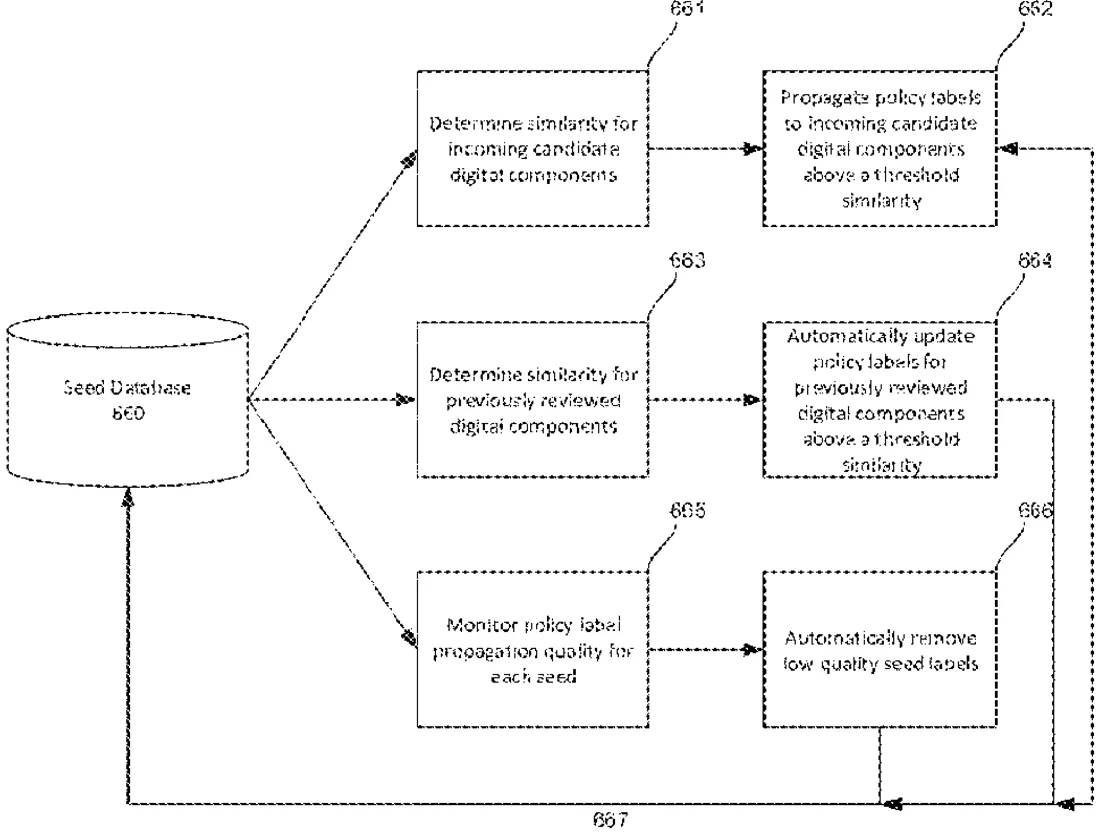
Google describes a method for checking if digital content breaks company rules. It uses a machine learning model to flag violations, but only checks new content that looks different from items already reviewed to save time. The system then spreads these violation labels to similar content.
In the filing’s own words
The technology is generally directed to determining whether candidate digital components violate a policy and using the determination to propagate policy labels. Candidate digital components may be filtered such that only a subset of the candidate digital components is provided to a machine learning model for further policy review. The machine learning model may provide a confidence score associated with the policy violation prediction. The policy violation prediction may be “violates policy” or “does not violate policy.” A label corresponding to the policy violation prediction may be associated with the digital component. The confidence score may be used when determining whether to use the policy violation prediction to propagate labels to other digital components. The labels may be propagated using a seed based enforcement system or a neighborhood based propagation system.
What exactly they claim (claim 1)
1. A method, comprising: determining, by one or more processors, embeddings associated with a plurality of candidate digital components and previously reviewed digital components; determining, by one or more processors based on the determined embeddings, a similarity between the candidate digital components and previously reviewed digital components, the similarity comprising at least one of a content similarity or a content provider similarity; identifying, by the one or more processors, a subset of digital components from the plurality of candidate digital components, wherein the subset of digital components includes one or more digital components having the similarity below a threshold similarity; providing, by the one or more processors, the identified subset of digital components as input to a machine learning model; determining, by the one or more processors executing the machine learning model, that digital components of the subset of digital components violate a policy; generating as output, by the one or more processors executing the machine learning model, based on the determined policy violation, one or more labels for the subset of digital components; and propagating, by the one or more processors, after the one or more labels are output for the subset of digital components by the machine learning model, the one or more labels to other digital components, wherein the other digital components are outside of the subset of digital components.
Facts
- Company
- Google (Google LLC)
- Official title
- System and method for policy enforcement
- Patent number
- US12754981B2
- Application number
- 18561379
- Filed
- Sep 14, 2023
- Granted
- Oct 6, 2026
- Inventors
- 13
- Claims
- 20
Classified under
G06F 21/16 Physics & computingG06F 21/1066 Physics & computingG06F 16/583 Physics & computingMore from Google in Security & privacy
- Google patents privacy score for third-party apps Sep 22, 2026
- Google patents phone feature to disable unknown trackers Oct 8, 2026
- Google patents local face recognition for smart home cameras Sep 10, 2026
- Google patents system that finds and fills in email verification codes Sep 17, 2026
- Google patents AI agents that automatically investigate network security threats Oct 8, 2026
Summaries are simplified from the filing’s own abstract and first claim. A patent filing is not a product announcement.
Patent data and drawings: U.S. Patent and Trademark Office (USPTO). Nebula is not affiliated with or endorsed by the USPTO.