Meta patents VR hand controls that lock to objects for better grip
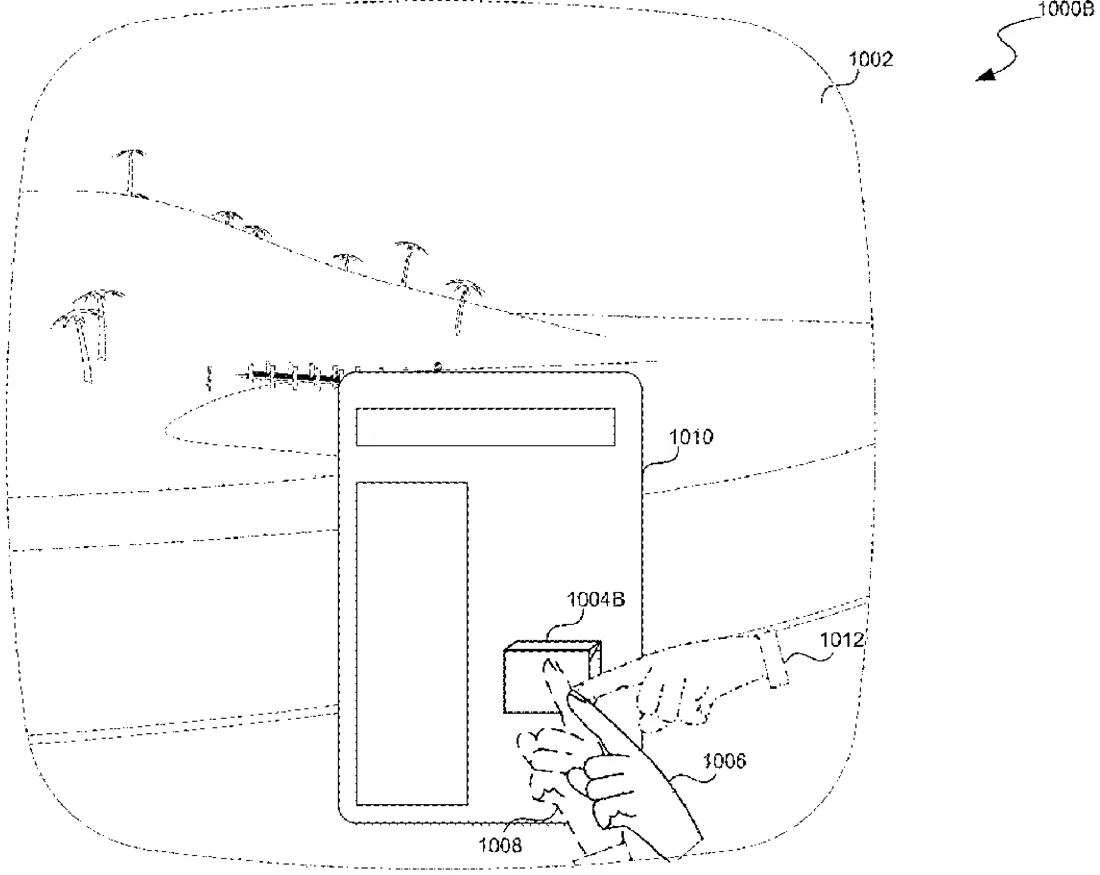
Meta describes a system for virtual reality where your digital hand snaps to a virtual object when you try to grab it, rather than just floating near it. While locked, the system shows a separate visual cue of your real hand's position to help you understand where your actual fingers are. This design also limits how much your virtual wrist can rotate to match the physical limits of holding an item.
In the filing’s own words
Aspects of the present disclosure can modify a user interface of an artificial reality system based on an ascertained intent of the user. For example, some implementations can “lock” a user's virtual hand to a virtual object displayed on the user interface when a user intends to interact with it with their physical hand, instead of tracking the physical hand with the virtual hand. While the virtual hand is “locked” to the virtual object, some implementations can further A) render another representation of the physical hand, separate from the virtual hand, corresponding to the actual location of the physical hand, B) render a visual affordance on the virtual hand based on movement of the physical hand, and/or C) restrict the amount of wrist rotation that is shown by the virtual hand when the physical hand interacts with the virtual object.
What exactly they claim (claim 1)
1. A method for providing intent-based user interface modifications in an artificial reality environment, the method comprising: identifying, by an artificial reality system, a physical hand in a real-world environment of a user; associating the physical hand with a virtual hand in the artificial reality environment, the virtual hand being a first representation of at least a first portion of the physical hand; displaying the virtual hand by the artificial reality system, the virtual hand tracking motion of the physical hand in the real-world environment; identifying an intent, to interact with a virtual object by the user, based on a gesture directed toward the virtual object or a proximity of the physical hand with the virtual object, wherein the intent to interact is a pressing motion by the physical hand relative to the virtual object; based on the identifying the intent to interact, displaying the virtual hand, in the pressing motion, compressing the virtual object; determining that the virtual object has reached its maximum compression based on the pressing motion of the physical hand relative to the virtual object; in response to the identifying the intent and the determining that the virtual object has reached its maximum compression, modifying tracking and display of the virtual hand to be based on a position of the virtual object, such that a position of the virtual hand is different from a position of the physical hand; and displaying, in addition to the displayed virtual hand, a second representation of at least a second portion of the physical hand, the second representation tracking a position of the at least the second portion of the physical hand.
Facts
- Company
- Meta (Meta Platforms Technologies, LLC)
- Official title
- Intent-based user interface modifications in an artificial reality environment
- Patent number
- US12754604B2
- Application number
- 18986021
- Filed
- Dec 18, 2024
- Granted
- Oct 6, 2026
- Inventors
- 6
- Claims
- 20
Classified under
G06F 3/011 Physics & computingG06F 3/017 Physics & computingG06T 13/40 Physics & computingG06T 19/00 Physics & computingG06T 2200/24 Physics & computingG06T 2210/62 Physics & computingMore from Meta in AR, VR & displays
- Meta patents VR avatars that mimic facial expressions from voice Sep 15, 2026
- Meta patents spatial mouse for pointing at and controlling real-world objects Sep 24, 2026
- Meta patents AR notifications that grow when you look at them Sep 1, 2026
- Meta patents AR glasses with antennas built into the lenses Sep 8, 2026
- Meta patents auto-pause for VR headsets when you take them off Oct 6, 2026
Summaries are simplified from the filing’s own abstract and first claim. A patent filing is not a product announcement.
Patent data and drawings: U.S. Patent and Trademark Office (USPTO). Nebula is not affiliated with or endorsed by the USPTO.