Samsung patents vacuum that checks if its base is full using pressure
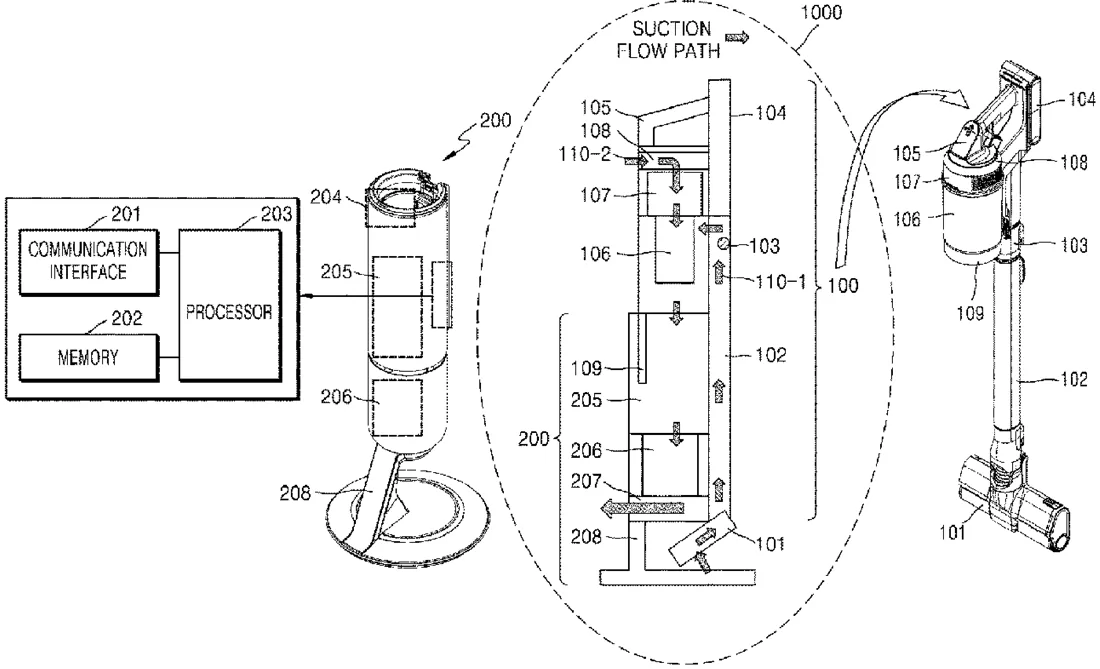
Samsung has been granted a patent for a cordless vacuum system that monitors the cleanliness of its charging base. The vacuum uses a built-in sensor to measure air pressure during dust transfer and compares it to a baseline to detect if the base's dust bin is clogged or full.
In the filing’s own words
A vacuum cleaner system is provided. The vacuum cleaner includes a wireless vacuum cleaner for discharging dust to a station device, wherein the wireless vacuum cleaner is configured to, when performing a dust discharge operation to the station device, determine a state of a dust collection part included in the station device, based on a pressure ratio between pressure values measured by a sensor mounted on the wireless vacuum cleaner, and output a notification indicating the determined state.
What exactly they claim (claim 1)
1. A wireless vacuum cleaner for discharging dust to a station device, the wireless vacuum cleaner comprising: a first dust collection part configured to collect dust introduced to the wireless vacuum cleaner; a first suction motor configured to generate suction power for collecting dust in the first dust collection part; a sensor mounted on a portion of a first suction flow path of the wireless vacuum cleaner; memory, comprising one or more storage media, storing instructions; and at least one processor communicatively coupled to the first suction motor, the sensor and the memory, wherein the instructions, when executed by the at least one processor individually or collectively, causes the wireless vacuum cleaner to: obtain, as a first pressure value, a pressure value measured by the sensor when a second suction motor of the station device operates while there is no dust in the first dust collection part and a second dust collection part of the station device; obtain, as a second pressure value, a pressure value measured by the sensor when a dust discharge operation in which dust of the first dust collection part is discharged to the second dust collection part of the station device is performed; detect a ratio of the second pressure value to the first pressure value; determine a state of the second dust collection part according to the detected ratio; and output notification information indicating the determined state of the second dust collection part.
Facts
- Company
- Samsung (Samsung Electronics Co., Ltd.)
- Official title
- Vacuum cleaner system notifying state of dust collection part and operating method of vacuum cleaner system
- Patent number
- US12751592B2
- Application number
- 18541704
- Filed
- Dec 15, 2023
- Granted
- Oct 6, 2026
- Inventors
- 5
- Claims
- 20
Classified under
A47L 9/2842 Human necessitiesA47L 9/0063 Human necessitiesA47L 9/2821 Human necessitiesA47L 9/2873 Human necessitiesA47L 2201/06 Human necessitiesMore from Samsung in Robots & automation
- Samsung patents robot that turns toward people based on who is speaking Oct 1, 2026
- Samsung patents robot vacuum that adjusts suction based on floor type Sep 8, 2026
- Samsung patents robot that adjusts hearing based on nearby objects Sep 8, 2026
- Samsung patents vacuum that senses floor type via pressure and motor load Sep 15, 2026
- Samsung patents robot that learns from user feedback on camera views Sep 15, 2026
Summaries are simplified from the filing’s own abstract and first claim. A patent filing is not a product announcement.
Patent data and drawings: U.S. Patent and Trademark Office (USPTO). Nebula is not affiliated with or endorsed by the USPTO.