Apple patents wireless headset that streams 3D video from a base station
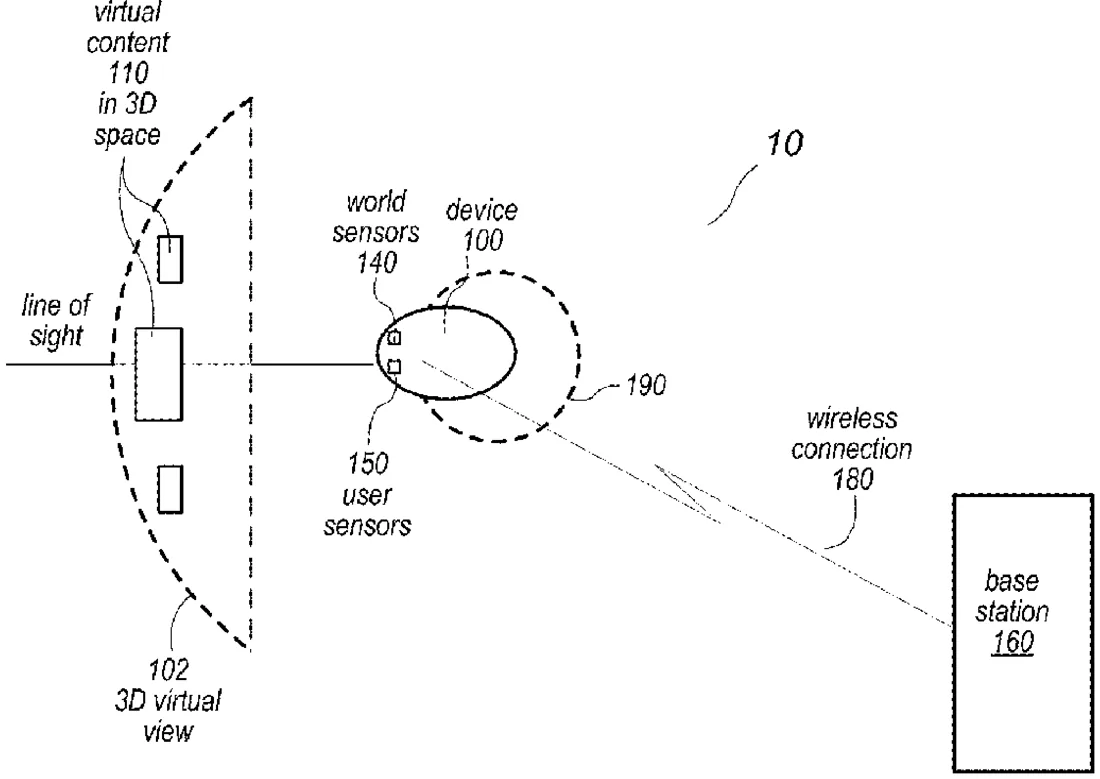
Apple describes a mixed reality setup where a lightweight headset sends camera footage to a separate base station for processing. The base station renders the 3D visuals, compresses them, and sends them back over a wireless connection for display, allowing the headset to remain untethered.
In the filing’s own words
A mixed reality system that includes a device and a base station that communicate via a wireless connection The device may include sensors that collect information about the user's environment and about the user. The information collected by the sensors may be transmitted to the base station via the wireless connection. The base station renders frames or slices based at least in part on the sensor information received from the device, encodes the frames or slices, and transmits the compressed frames or slices to the device for decoding and display. The base station may provide more computing power than conventional stand-alone systems, and the wireless connection does not tether the device to the base station as in conventional tethered systems. The system may implement methods and apparatus to maintain a target frame rate through the wireless link and to minimize latency in frame rendering, transmittal, and display.
What exactly they claim (claim 1)
1. A system, comprising: a base station comprising one or more processors; and a device, comprising: one or more processors; one or more cameras configured to capture frames that include views of a user's environment; and a display subsystem for displaying a 3D virtual view to the user; wherein the device is configured to: transmit frames captured by the one or more cameras to the base station over a wireless connection; wherein the base station is configured to: render the frames or frame portions; compress the rendered frames or frame portions; and transmit the compressed frames or frame portions to the device over the wireless connection; wherein the device is configured to decompress the compressed frames or frame portions received from the base station and provide the rendered frames or frame portions to the display subsystem for display; and wherein the device is configured to: monitor the wireless connection to the base station; and in response to detecting that the wireless connection to the base station has been lost: render, by the device, one or more frames that include views of the user's environment based on the frames captured by the one or more cameras; and provide the rendered one or more frames to the display subsystem for display.
Facts
- Company
- Apple (Apple Inc.)
- Official title
- Video pipeline
- Patent number
- US12749254B2
- Application number
- 18797340
- Filed
- Aug 7, 2024
- Granted
- Sep 29, 2026
- Inventors
- 13
- Claims
- 20
Classified under
G06T 15/005 Physics & computingG06F 3/012 Physics & computingG06T 3/18 Physics & computingG06T 9/00 Physics & computingH04W 76/10 Electricity & electronicsH04W 88/08 Electricity & electronicsMore from Apple in AR, VR & displays
- Apple patents AR glasses that zoom in on what you look at Sep 8, 2026
- Apple patents finger ring that controls VR with taps and waves Sep 15, 2026
- Apple patents head-mounted device that types via eye swipes and hand pinches Oct 6, 2026
- Apple patents eye-tracking and hand gestures to select screen items Oct 20, 2026
- Apple patents AR glasses that adjust lenses to fit your eyes Sep 17, 2026
Summaries are simplified from the filing’s own abstract and first claim. A patent filing is not a product announcement.
Patent data and drawings: U.S. Patent and Trademark Office (USPTO). Nebula is not affiliated with or endorsed by the USPTO.