Nvidia patents method to stop virtual characters from floating or sliding
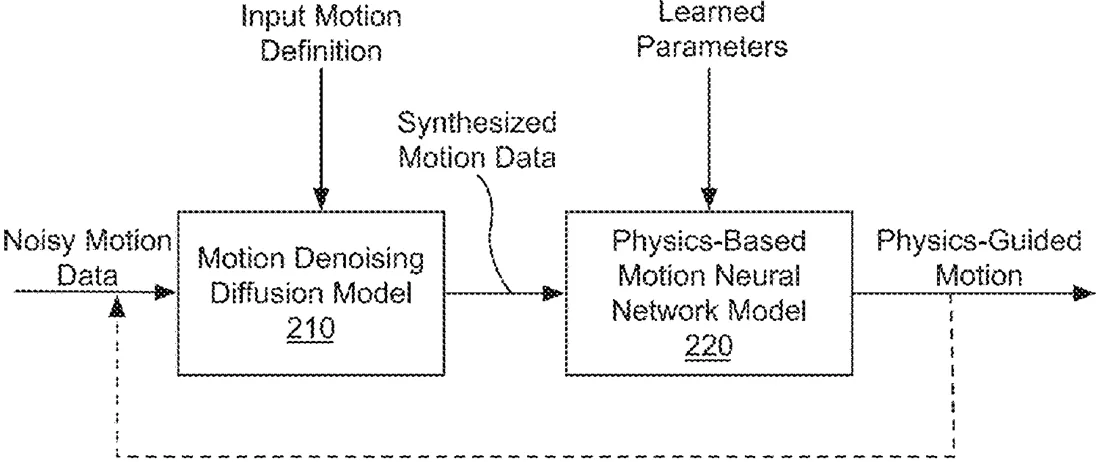
Nvidia describes a technique that combines a standard motion-generating AI with a physics simulator to ensure virtual characters move realistically. The system checks the AI's output against physical laws, like gravity and ground contact, and corrects errors such as feet sliding or bodies passing through floors. This process repeats until the movement looks natural and obeys the rules of the environment.
In the filing’s own words
Systems and methods are disclosed that improve performance of synthesized motion generated by a diffusion neural network model. A physics-guided motion diffusion model incorporates physical constraints into the diffusion process to model the complex dynamics induced by forces and contact. Specifically, a physics-based motion projection module uses motion imitation in a physics simulator to project the denoised motion of a diffusion step to a physically plausible motion. The projected motion is further used in the next diffusion iteration to guide the denoising diffusion process. The use of physical constraints in the physics-guided motion diffusion model iteratively pulls the motion toward a physically-plausible space, reducing artifacts such as floating, foot sliding, and ground penetration.
What exactly they claim (claim 1)
1. A method, comprising: processing, by a diffusion neural network model, an input motion definition and noisy motion data to produce synthesized motion data for a character for a diffusion timestep of multiple diffusion timesteps; selectively disabling processing by a physics-based motion neural network model based on a mean motion of a denoising distribution and a noise level of the synthesized motion data, wherein the mean motion corresponds to physically-incorrect motion; for each diffusion timestep that a physics-based motion neural network model is not disabled, applying learned parameters, by the physics-based motion neural network model, to adapt the synthesized motion data to physical constraints of an environment on the character producing physics-guided motion data that is specific to the character and physically plausible, wherein the physics-guided motion data corresponds to the input motion definition; for each specific diffusion timestep that the physics-based motion neural network model is disabled, providing the synthesized motion data as the physics-guided motion data; and repeating the processing and applying for one or more remaining diffusion timesteps, wherein the physics-guided motion data replaces the noisy motion data for each iteration of the processing and applying.
Facts
- Company
- Nvidia (NVIDIA Corporation)
- Official title
- Physics-guided motion diffusion model
- Patent number
- US12749248B2
- Application number
- 18317378
- Filed
- May 15, 2023
- Granted
- Sep 29, 2026
- Inventors
- 5
- Claims
- 20
Classified under
G06T 13/40 Physics & computingG06T 5/70 Physics & computingG06T 13/80 Physics & computingG06T 2207/20081 Physics & computingG06T 2207/20084 Physics & computingMore from Nvidia in AI & software
- Nvidia patents AI coach that analyzes your gameplay to suggest strategies Oct 13, 2026
- Nvidia patents AI system that writes and voices character conversations Sep 10, 2026
- Nvidia patents system that uses AI to find bugs in game videos Sep 17, 2026
- Nvidia patents AI method to make digital characters move realistically Sep 8, 2026
- Nvidia patents AI system that builds image generators from text prompts Sep 15, 2026
Summaries are simplified from the filing’s own abstract and first claim. A patent filing is not a product announcement.
Patent data and drawings: U.S. Patent and Trademark Office (USPTO). Nebula is not affiliated with or endorsed by the USPTO.