Apple patents tracking objects when they disappear from camera view
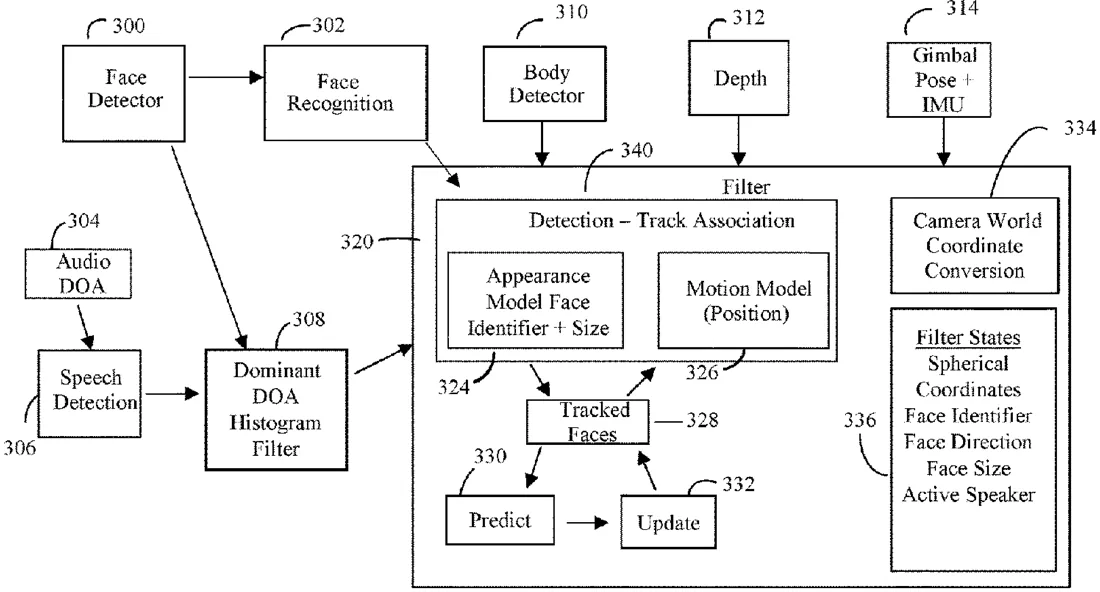
Apple has been granted a patent for a method that tracks objects by combining data from a camera and two other sensing types. When an object leaves the camera's field of view, the system predicts its position by weighing the data from the different sensors based on specific conditions.
In the filing’s own words
Some methods are described herein for tracking one or more objects. In some examples, the method is performed at a computer system. In some examples, the method includes receiving a first set of data corresponding to the object via a first modality and a second set of data corresponding to the object via a second modality; after receiving the first set of data corresponding to the object and the second set of data corresponding to the object, receiving a second set of image data representing the field of view of the camera, wherein the second set of image data does not include data representative of the object; and after receiving the second set of image data, predicting a position of the object using at least the first set of data corresponding to the object and the second set of data corresponding to the object.
What exactly they claim (claim 1)
1. A method, comprising: receiving, via a camera that is in communication with a computer system, a first set of image data representing a field of view of the camera, wherein the first set of image data at least includes data representative of an object in the field of view of the camera; receiving a first set of data corresponding to the object via a first modality and a second set of data corresponding to the object via a second modality, wherein the first modality is a different type of modality than the second modality; after receiving the first set of data corresponding to the object and the second set of data corresponding to the object, receiving a second set of image data representing the field of view of the camera, wherein the second set of image data does not include data representative of the object; and after receiving the second set of image data, predicting a position of the object, wherein predicting the position of the object includes: in accordance with a determination that a first set of one or more criteria is satisfied: assigning a first weight to the first set of data of the object; assigning a second weight to the second set of data of the object, wherein the first weight is greater than the second weight; and in accordance with a determination that a second set of one or more criteria is satisfied: assigning a third weight to the first set of data of the object, wherein the third weight is different from the first weight; and assigning a fourth weight to the second set of data of the object, wherein the fourth weight is greater than the third weight, wherein the fourth weight is different from the second weight, and wherein the second set of one or more criteria is different from the first set of one or more criteria.
Facts
- Company
- Apple (Apple Inc.)
- Official title
- Techniques for tracking one or more objects
- Patent number
- US12749216B2
- Application number
- 18584794
- Filed
- Feb 22, 2024
- Granted
- Sep 29, 2026
- Inventors
- 4
- Claims
- 24
Classified under
G06T 7/70 Physics & computingG06T 5/20 Physics & computingMore from Apple in AI & software
- Apple patents AI that acts on voicemails for you Oct 15, 2026
- Apple patents letting users teach custom hand gestures to their devices Oct 22, 2026
- Apple patents AI that acts on voicemails for you Sep 1, 2026
- Apple patents video tool that swaps focus between subjects after filming Oct 20, 2026
- Apple patents system that changes room ambience based on what you look at Sep 3, 2026
Summaries are simplified from the filing’s own abstract and first claim. A patent filing is not a product announcement.
Patent data and drawings: U.S. Patent and Trademark Office (USPTO). Nebula is not affiliated with or endorsed by the USPTO.